For years, people have been leaving expensive states in the Northeast and on the West Coast and heading towards Florida, Texas, and Arizona.
Warm weather, lower taxes, more affordable homes, and the possibility of remote working fuelled the Sun Belt migration boom.
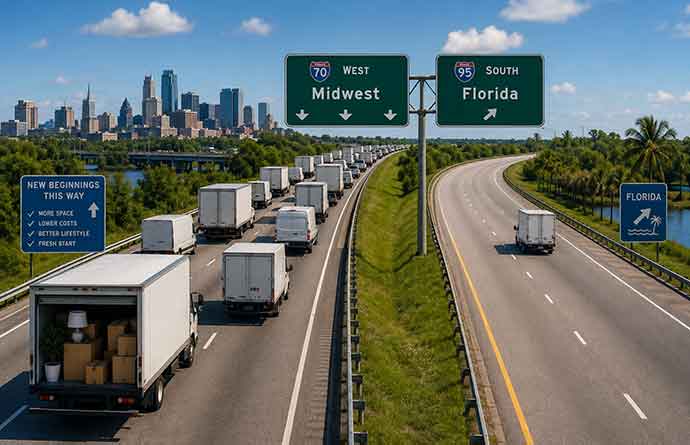
But migration patterns are changing. The Sun Belt boom is not over, but it is not attracting the masses it once did.
Whilst Texas, Arizona, North Carolina, and South Carolina continue to attract large numbers of people, Florida has experienced a dramatic slowdown.
At the same time, Ohio and Michigan have moved from major domestic migration losses in 2021 to gains in 2025.
The latest Census estimates do not show Americans forsaking the South for snowier states; they show something more interesting: the country’s migration map is becoming less predictable and is increasingly being driven by the cost of living rather than good weather.
Key takeaways
Florida’s net domestic migration fell from 310,892 in 2022 to just 22,517 in 2025.
Ohio went from losing 32,482 domestic migrants in 2021 to gaining 11,926 in 2025.
Michigan moved from a loss of 28,290 in 2021 to a gain of 1,796.
The Midwest recorded positive net domestic migration in 2025 for the first time this decade.
North Carolina, Texas, South Carolina, Tennessee, and Arizona remain major migration winners, so this is a redistribution of growth rather than the death of the Sun Belt.
How Much do Movers Cost?
Save up to 40% on your upcoming move and get a quote from reputable moving experts.
The Sun Belt Boom is Slowing, but not Disappearing
North Carolina recorded the largest net domestic migration gain in 2025, followed by Texas and South Carolina.
Tennessee and Arizona also remained among the leading destinations, while Florida still gained more domestic migrants than it lost, but it fell to eighth place after being near or at the top for the last decade.
2025 in these estimates refers to the period from July 1, 2024 to June 30, 2025.
State
Net domestic migration, 2021
Net domestic migration, 2025
Direction
Florida
+253,220
+22,517
Dramatic slowdown
Texas
+199,360
+67,299
Still strong, but slower
Arizona
+84,233
+31,107
Still gaining
North Carolina
+103,627
+84,064
Major destination
South Carolina
+68,406
+66,622
Consistently strong
Ohio
-32,482
+11,926
A big swing
Michigan
-28,290
+1,796
Modest recovery
Florida’s net domestic migration peaked at 310,892 in 2022 before falling to 183,646 in 2023, 58,411 in 2024, and 22,517 in 2025.
Florida is still attracting people, but its domestic migration gain has fallen by more than 90% from the 2022 peak.
Texas tells the same story, just not as dramatically. It remains one of America’s leading destinations, but its net domestic gain has declined from more than 200,000 during the pandemic-era peak to approximately 67,000 in 2025.
Arizona also continues to gain residents, although its migration numbers are considerably lower than they were earlier in the decade.
Previously, we would have said that almost any growing Sun Belt metro would continue to attract many new people.
The new reality is that individual states and cities have to compete much harder on housing, insurance, employment, and quality of life.
You may also like to read: The 3% Mortgage Prison. Many people will not move because they are locked into a 3% mortgage rate. But is that rate costing you more than you think? In this guide, we find out.
Why Florida, Texas, and Arizona Are Less Attractive Now
Historically, it was easy to understand why the Sun Belt was so popular:
Sell an expensive home in California, New York, or New Jersey.
Buy a larger home in Florida, Texas, or Arizona.
Pay no state income tax in Florida or Texas.
Enjoy warmer winters and, in many cases, lower everyday expenses.
Those figures worked well for higher-income remote workers, homeowners with large amounts of equity, and retirees leaving expensive coastal states.
But the decision to move is rarely based on taxes or home prices alone; people have to pay: mortgage interest, property taxes, insurance, utilities, transportation, maintenance, commuting, and any future risks.
In many parts of the Sun Belt, those additional costs have begun to chip away at the original savings.
You may also like to read: How to Find the Best City for You. In this guide, we suggest things to take into consideration when choosing which city to move to.
Sun Belt Housing is No Longer Cheap Everywhere
Years of sustained population growth pushed up prices in many of the cities that had been regarded as affordable.
By late 2025, the national housing market had split into two different regional patterns.
Many Florida and Texas metros had large numbers of sellers competing for fewer buyers.
Austin had an estimated 128% more sellers than buyers in December 2025.
Fort Lauderdale, Miami, San Antonio, and several other Sun Belt metros also ranked among the country’s strongest buyers’ markets.
Zillow reported in August 2025 that typical home values were falling fastest in Tampa, Austin, Miami, Orlando, and Dallas. At the same time, Cleveland, Detroit, Buffalo, and other Midwest or Great Lakes markets continued to record annual price growth.
Falling Sun Belt prices may sound like good news for movers, and in some cases, they are, as buyers may be able to get discounts, builder incentives, or greater negotiating power.
The problem is that a small price reduction does not instantly make a home affordable after several years of appreciation, particularly when mortgage rates, property taxes, and insurance costs are rising.
Insurance Costs are Becoming Increasingly Important
Home insurance was once a fairly predictable entry in a household budget. That is becoming increasingly difficult in states exposed to hurricanes, hail, flooding, wildfire, or severe storms.
Texas reported an average annual homeowner’s premium of $3,506 for 2025. State data shows average homeowners rate changes of 10.8% in 2022, 21.1% in 2023, 18.7% in 2024, and a further 4.3% in 2025.
Arizona’s Department of Insurance has warned that homeowners insurance premiums are increasing across the state, not only in the areas considered most exposed to wildfire.
Florida’s insurance market has recently shown signs of stabilization, including insurers filing for decreases or no rate change.
However, insurance premiums, hurricane exposure, flood coverage, and rising condominium costs continue to affect what residents pay to live there.
A $400,000 home in Florida or Texas may still appear attractive beside a $650,000 home in the Northeast. But once you add insurance, property taxes, HOA fees, cooling costs, and the possibility of future premium increases, the difference is not so big.
You may also like to read: Is Your Home Becoming Uninsurable? In this guide, we look at how the cost of home insurance is influencing people’s decisions on whether to move or stay, and where they should move.
More Housing Supply Means It’s a Buyers’ Market
Many Southern and Western cities built more homes to cope with the population growth.
Realtor.com reported that in November 2025, housing inventory in the South was 5.7% above its pre-pandemic levels. Midwest inventory remained 32.9% below its historic baseline. Austin had 42.8% more inventory than its pre-pandemic levels, while Chicago remained 55.1% below its comparable level.
This explains what seems to be a contradiction.
Sun Belt markets can continue to gain residents whilst still becoming buyer’s markets because they built enough housing to give purchasers more choice.
In the Midwest, population growth can be lower, while limited inventory pushes prices higher and increases competition for the available homes.
The Midwest is Recovering, Slowly
The Census Bureau reported that the Midwest gained approximately 16,000 net domestic migrants in 2025.
That was the region’s first positive domestic migration result of the decade and a reversal from losses of at least 175,000 in both 2021 and 2022.
Ohio changed from a net domestic migration loss of 32,482 in 2021 to a gain of 11,926 in 2025. Michigan moved from a loss of 28,290 to a gain of 1,796.
Other Midwest states, including Missouri, Indiana, Minnesota, and Wisconsin, also recorded positive net domestic migration in the Vintage 2025 estimates.
This does not yet mean a mass return to the Rust Belt; Michigan’s gain of fewer than 2,000 people is small, and Illinois continues to experience substantial domestic migration losses.
Migration patterns don’t usually reverse all at once; it starts with fewer residents leaving, more former residents returning, and a growing number of outsiders beginning to consider places they previously ignored.
The Midwest may now be entering that early stage.
You may also like to read: Will the Midterms Affect Where People Move? In this guide, we look at how the results of the midterms could affect where people choose to move next.
Affordability Is the New Migration Driver
The Midwest is so attractive because of the possibility of buying a reasonably priced home near a large employment center.
In July 2025, more than half of the homes listed in Detroit, Cleveland, St. Louis, Pittsburgh, and Buffalo were considered affordable to a household earning the local median income.
Nationally, less than one-third of listings were equally affordable.
Regional prices show the same divide.
During the fourth quarter of 2025, the median existing single-family home price was approximately $317,100 in the Midwest, compared with $367,300 in the South, and $625,800 in the West.
Midwest prices were still rising faster than prices in the South, suggesting that buyers had already started competing for the region’s limited supply.
Realtor.com found that out-of-market interest in Midwest homes increased substantially between 2019 and 2025. The average share of views coming from nonlocal shoppers rose from 40.8% to 55.8% among major Midwest metros.
In Detroit, out-of-state buyers accounted for 29.2% of its property views in late 2019, and by late 2025, the share had risen to 52.4%.
Cleveland, Milwaukee, Omaha, and several other central or Great Lakes metros recorded similar increases in outside interest.
Search activity does not always result in an actual move, but it shows which previously ignored markets are now being considered by buyers.
You may also like to read: The Rising Cost of Property Tax. In this guide, we look at how the rising cost of property tax can influence where you choose to live next.
Where will Americans Move Next?
The next migration wave is unlikely to be one clear destination over Florida or Texas.
Instead, Americans will probably be divided among destinations.
1. Ohio’s major metropolitan corridor
Ohio may see a sustained Midwest recovery.
Columbus offers a large and diverse employment base, whilst Cincinnati combines a major corporate presence with access to Ohio, Kentucky, and Indiana. Cleveland offers some of the most affordable housing among large U.S. metro areas, along with established healthcare, education, and cultural institutions.
The state’s domestic migration turnaround is already larger than Michigan’s, and Cleveland has experienced a substantial increase in interest from out-of-state movers.
However, not everywhere in Ohio is affordable. Canton, Youngstown, and other Ohio markets recorded some of the country’s highest home-price increases in late 2025.
Growing demand along with limited construction could quickly make the most desirable neighborhoods more expensive.
Best suited to: First-time buyers, families seeking larger homes, healthcare workers, hybrid employees, and people returning to be closer to relatives.
You may also like to read: Moving to Columbus, Ohio. In this guide, we share all you need to know about living in Columbus, Ohio.
2. Detroit, Grand Rapids, and Southeast Michigan
Michigan’s gain was small, but it showed an important break from years of domestic migration losses.
Detroit is attracting more outside buyers, while its housing remains affordable compared to most large metropolitan areas. Its existing infrastructure, border location, manufacturing base, and expanding technology-related investment make it an attractive destination.
Grand Rapids may appeal to movers seeking a smaller metropolitan area with access to Lake Michigan, whilst Ann Arbor remains more expensive but offers education, healthcare, and research employment.
We are unlikely to see millions of people moving into Detroit, but we may see a gradual reduction in outbound migration, combined with growth in the state’s strongest employment and lifestyle markets.
Best suited to: Those seeking homeownership, manufacturing and technology workers, returning Midwesterners, and families looking for established communities.
You may also like to read: Moving to Detroit, Michigan. From cost of living to best schools, neighborhood comparisons to career opportunities, if you are thinking of moving to Detroit, then this guide is invaluable.
3. Wisconsin, Indiana, Missouri, and Minnesota
Indiana and Missouri recorded net domestic migration gains of more than 10,000 in 2025, while Wisconsin and Minnesota also recorded positive gains.
Major markets such as Indianapolis, Milwaukee, St. Louis, and Minneapolis offer different combinations of housing affordability, employment, transportation, and urban amenities.
Milwaukee was one of only five large markets classified as a seller’s market at the end of 2025, showing that demand can be strong even in a colder-weather city.
St. Louis also stood out for affordability: more than half of its July 2025 listings were affordable to a median-income household.
These cities may appeal to movers who want lower prices without choosing a rural area or giving up access to major hospitals, airports, and employers.
You may also like to read: Moving to Indianapolis. From career opportunities to education, public transport to crime rates, if you are thinking of moving to Indianapolis, then this guide is invaluable.
4. The Carolinas and the inland Southeast
The Midwest is recovering, but the largest number of movers are still heading south.
North Carolina added more net domestic migrants than any other state in 2025.
South Carolina ranked third and recorded the country’s fastest overall percentage population growth. Tennessee, Alabama, and Georgia also continued to gain residents.
This suggests that many Americans are shifting away from the most expensive or risk-exposed Sun Belt markets toward smaller Southern cities and inland areas.
The Carolinas may eventually replace Florida as the preferred destination for some retirees and lifestyle movers. They offer warmer weather than the Midwest, access to the coast or mountains and, in many areas, lower housing and insurance costs than South Florida.
The danger is that the same cycle could repeat; Rapid migration could push prices higher, increase traffic, put undue pressure on infrastructure, and eventually become less affordable.
You may also like to read: Moving to North Carolina. In this guide, we look at the pros and cons of moving to North Carolina.
5. Great Lakes and the Wider Area
The wider Great Lakes region includes several places that are not always classified as part of the Midwest.
Pittsburgh, Buffalo, and Rochester have relatively affordable housing, universities, good healthcare systems, and established infrastructure.
More than half of listings in Pittsburgh and Buffalo were affordable to median-income households in July 2025.
Realtor.com also recorded significant growth in out-of-market interest in Pittsburgh, Rochester, and Buffalo between 2019 and 2025.
These places may be better for buyers who want Midwest-style affordability but prefer the Northeast, proximity to family, or access to established East Coast employment networks.
Why Americans May Stop Choosing States and Start Choosing Individual Cities
The pandemic encouraged people to think in terms of states, but the next phase will probably be more local.
Insurance costs can differ dramatically between coastal and inland locations within the same state, whilst property taxes can vary by county.
Employment opportunities are concentrated around particular metropolitan areas whilst water availability, school quality, commute times, housing construction, and healthcare access can be very different within a few miles.
The most popular destinations will therefore be cities that can offer:
Affordable housing.
Reliable insurance.
Diverse employment.
Reasonable property taxes.
Access to healthcare.
Functional infrastructure.
A sufficient supply of homes.
Manageable exposure to weather and environmental risks.
Who is Most Likely to Drive the Next Migration Wave?
First-time homebuyers
First-time buyers have the strongest reason to look beyond established Sun Belt destinations.
They generally have less home equity, smaller down payments, and are usually more budget-conscious.
A lower purchase price in Cleveland, Detroit, or St. Louis may matter more than having no state income tax elsewhere.
Families seeking more space
Families that cannot afford a larger home in coastal or booming Sun Belt cities may look towards suburbs around Columbus, Cincinnati, Indianapolis, Grand Rapids, or Milwaukee.
For these movers, schools, commute times, and the availability of three- or four-bedroom homes may be more important than climate.
Returning Midwesterners
Some of the Midwest’s recovery may come from people moving back, rather than arriving for the first time, as remote and hybrid work can allow former residents to return while retaining jobs based in more expensive cities.
Aging parents, childcare support, and established family networks can make returning financially and emotionally appealing.
Florida will remain a popular retirement destination, but it may no longer be the automatic choice.
Some retirees may choose South Carolina, North Carolina, Tennessee, Georgia, or lower-cost inland communities, whilst others may remain closer to family rather than moving across the country.
Insurance availability, healthcare access, and total housing expenses are likely to become more important than just winter temperatures.
What to Compare Before Choosing a Destination
The most common mistake is comparing only home prices.
Ideally, you need to compare the complete monthly and long-term cost of living in each destination:
Mortgage or rent.
Homeowners, condo, or renters insurance.
Flood, wind, or wildfire coverage where relevant.
Property taxes and special assessments.
State and local income taxes.
Heating and cooling costs.
Transportation and vehicle expenses.
HOA or condominium fees.
Expected earnings and employment stability.
Healthcare, childcare, and education costs.
The likelihood of future insurance or maintenance increases.
The cost of moving again if the destination does not work out.
The cheapest home is not always the cheapest place to live.
Likewise, a state with no individual income tax is not automatically less expensive once property taxes, insurance, and housing costs are included.
You may also like to read: Climate Migration. Climate change is increasingly an important consideration when choosing where to live next. In this guide, we look at where to move to avoid climate change.
Is the Sun Belt Boom Over?
No, but the Sun Belt may no longer be the automatic destination of choice.
North Carolina, Texas, South Carolina, Tennessee, and Arizona remain among America’s strongest domestic migration destinations.
Southern counties continue to hold many of the highest positions in the country’s migration rankings.
What has changed is the assumption that Florida, Texas, and Arizona will always offer the most obvious financial and lifestyle advantage.
Florida’s migration slowdown is substantial. Housing markets across Florida and Texas now show some of the country’s largest gaps between sellers and buyers.
Insurance and other ownership costs are forcing households to consider more than just the advertised purchase price.
Meanwhile, Ohio and Michigan have gone from domestic migration losses to gains, whilst other Midwest states are also attracting more residents than they are losing.
However, the next decade’s winners may be the metropolitan areas that still allow you to build a stable life without spending most of your income on housing.
The strongest domestic migration destinations in the 2025 Census estimates included North Carolina, Texas, South Carolina, Tennessee, and Arizona. Florida continued to gain residents but experienced a major slowdown. Ohio, Michigan, and several other Midwest states showed improving domestic migration patterns.
Is Florida still gaining residents?
Yes. Florida had positive net domestic migration of 22,517 in 2025. However, that was substantially lower than its gain of 310,892 in 2022, and Florida fell to eighth place among states for net domestic migration.
Are people moving back to Ohio?
Ohio recorded positive net domestic migration of 11,926 in 2025 after losing 32,482 domestic migrants in 2021. This is a significant turnaround, although migration patterns vary a lot between Ohio’s individual cities and counties.
Is Michigan gaining population again?
Michigan recorded a small positive net domestic migration gain of 1,796 in 2025, compared with a loss of 28,290 in 2021. The state’s overall recovery remains modest, but Detroit has also experienced a large increase in interest from out-of-market movers.
Why is Sun Belt migration slowing?
Mainly because of more expensive homes, higher mortgage rates, rising insurance and ownership costs, increased housing supply, and reduced affordability. Some areas of the Sun Belt are now strong buyer’s markets because sellers and builders are competing for fewer buyers.
Will the Midwest replace the Sun Belt?
It is unlikely. The Midwest’s migration recovery is still relatively small, while several Southern states continue to post much larger gains. The more likely outcome is a multi-region migration map in which affordable Midwest and Great Lakes metros compete with the Carolinas, Texas, Arizona, and other established destinations.
Are Midwest homes still affordable?
Generally, Midwest homes remain less expensive than homes in the South, Northeast, or West.
In July 2025, more than half of the listings in Detroit, Cleveland, and St. Louis were affordable to households earning the local median income. However, limited supply is already pushing prices up in several Midwest markets.
The Sun Belt boom is not over, but buyers are looking elsewhere.
Instead of looking at where taxes are lowest, or winters are warmest, Americans are comparing where housing, insurance, employment, and daily life make a more attractive package.
For many, the answer may be found in Ohio, Michigan, Wisconsin, Indiana, Missouri, or somewhere previously overlooked in the Great Lakes and Midwest.
The next great American migration story may not be about chasing the sun; it is more likely to be about chasing affordability.
Good luck with your move, and be sure to visit our home moving blog for guides to make every aspect of your move easier, cheaper, and safer, as well as plenty of state and city moving guides.
*At MoveAdvisor we will connect you with a professional moving company. Please note that we may not be affiliated with
and you may be speaking with another licensed provider.
We use cookies to optimise your experience.Accept and close or Learn more















Share your thoughts by leaving a comment