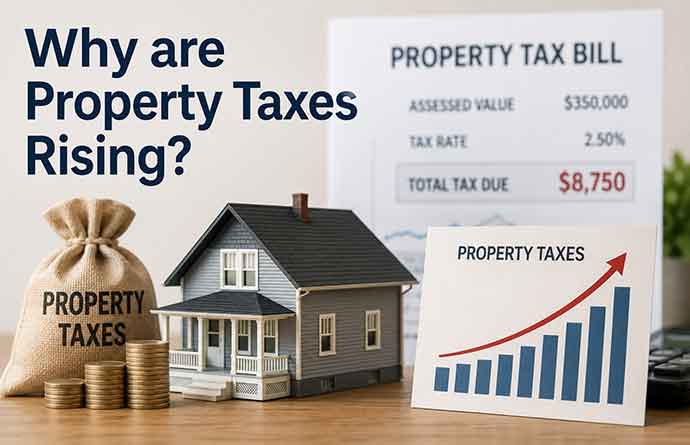
Property taxes are becoming a major concern for homeowners across the United States.
Even people with fixed-rate mortgages are finding that their monthly housing payments are increasing as local tax bills and escrow requirements rise.
As reported by ATTOM, in 2025, property taxes on U.S. single-family homes reached approximately $396.8 billion, an increase of 3.7% from the previous year.
The average bill rose to $4,427, while the national property tax rate increased from 0.86% to 0.90%.
Taxes rose even though average estimated home values fell slightly during the year.
For some people, a higher property tax bill is a price they are willing to pay for good schools, reliable public services, and a desirable location.
For others, especially retirees, people on fixed incomes, and owners who no longer use many local services, the increase could be a reason to downsize or move to a lower-tax area.
However, you should not base any decision on the tax bill alone because a state with low property taxes may have more expensive insurance, higher sales taxes, fewer public services, or unexpectedly high housing prices.
Moving can also trigger a new assessment, a higher mortgage rate, and thousands of dollars in transaction costs.
The Main Things to Consider
Before comparing states or looking at homes, keep in mind:
Property tax rates and actual tax bills are not the same thing.
County, city and school-district taxes are more important than the statewide average.
A home may be reassessed at its purchase price after it is sold.
Long-term owners can have protections that disappear when they move.
Lower property taxes can be offset by insurance, HOA fees, transportation and other taxes.
Moving usually makes more financial sense when you expect to live in the new home for many years.
Appealing an assessment or claiming an exemption may reduce the bill without requiring a move.
A property tax bill generally depends on two figures:
Taxable assessed value × local tax rate = base property tax
Exemptions, credits, bond payments, and special assessments can then raise or lower the final bill.
Property taxes may increase because:
The local government reassesses the home at a higher value.
The city, county, or school district raises its levy.
Voters approve a bond or special tax.
A temporary exemption expires.
New construction increases the taxable value.
Local labor, infrastructure, pension, and emergency-service costs rise.
The home changes ownership and is reassessed.
The local tax base shrinks, leaving remaining owners to carry more of the cost.
This is why a lower or static home value does not guarantee a lower tax bill.
Local governments can change tax rates irrespective of what is happening in the housing market.
Property taxes are an important and stable source of funding for local governments, and are used to support schools, police and fire departments, roads, libraries, parks, emergency services and other community services.
Property Tax Rate versus Property Tax Bill
A state can have a low tax rate but still result in a high bill if homes are expensive.
For example, a 0.5% effective rate on a $900,000 home results in a larger tax bill than a 1.5% rate on a $200,000 home:
$900,000 × 0.5% = $4,500
$200,000 × 1.5% = $3,000
This is especially important when comparing states such as Hawaii and California with states where homes are generally less expensive.
The most useful figure is not the statewide average rate; it is the projected tax bill on a specific home after the purchase has been recorded and all the new-owner exemptions have been applied.
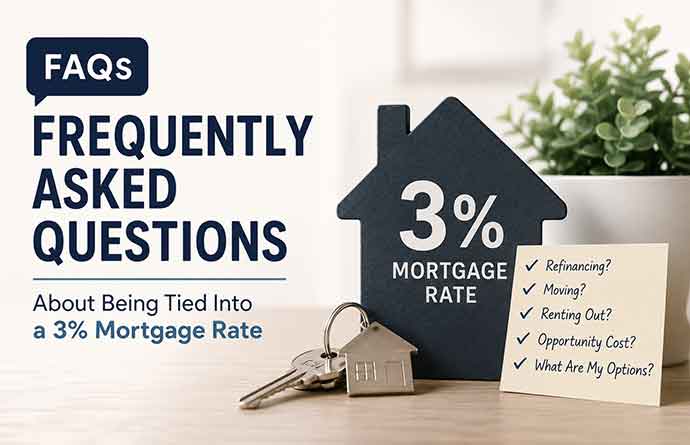
You may also like to read: The 3% Mortgage Trap. Is not moving because you have a 3% mortgage the right decision? In this guide, we find out.
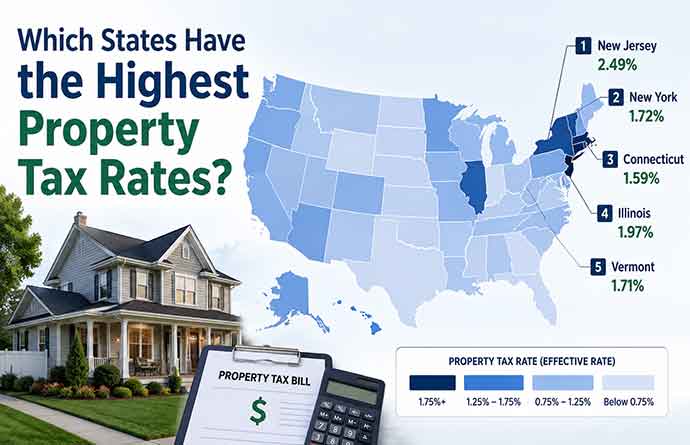
Which States Have the Highest Property Tax Rates?
The following comparison uses 2025 Census data analyzed by the Tax Foundation. The effective rate shows property taxes actually paid on owner-occupied housing as a percentage of housing value.
States with the highest effective property tax rates
State
Effective rate
New Jersey
1.88%
Illinois
1.88%
Connecticut
1.54%
Vermont
1.51%
New Hampshire
1.50%
Nebraska
1.44%
Texas
1.40%
Ohio
1.36%
Iowa
1.33%
Wisconsin
1.32%
New York
1.30%
Pennsylvania
1.26%
States near the middle
State
Effective rate
Massachusetts
1.00%
Minnesota
1.00%
South Dakota
1.00%
Maine
0.98%
Maryland
0.92%
Missouri
0.89%
Oregon
0.81%
Georgia
0.79%
Florida
0.78%
Virginia
0.78%
California
0.70%
North Carolina
0.66%
States with the lowest effective property tax rates
State
Effective rate
Tennessee
0.52%
West Virginia
0.51%
Nevada
0.50%
Colorado
0.50%
Idaho
0.50%
South Carolina
0.49%
Arizona
0.48%
Utah
0.48%
Alabama
0.37%
Hawaii
0.29%
Note that these are statewide averages. The bill for an individual property can differ substantially because of home values, exemptions, and local taxing districts.
Which States Have the Highest Actual Property Tax Bills?
High rates and high home values together can result in very large bills.
In 2025, the highest average single-family property tax bills were reported in:
New Jersey: $10,499
Connecticut: $8,901
New Hampshire: $8,174
Massachusetts: $7,904
New York: $7,732
At the other end of the scale, West Virginia had an average bill of $1,081, followed by Alabama at $1,284, Arkansas at $1,387, Mississippi at $1,563 and Louisiana at $1,639.
These averages are useful for seeing general patterns, but are not estimates for a specific house.
A modest home in an expensive-tax state may have a lower bill than a luxury home in a low-rate state.
Property tax burdens often vary significantly between neighboring counties, municipalities, and school districts.
You may also like to read: Uninsurable Zip Codes. Home insurance is becoming more and more expensive, and in some places homes are even becoming uninsurable. In this guide, we explore why homes become uninsurable and whether you should move before your home becomes unsellable.
Why Moving to a Low-Tax State Does Not Always Save Money
Property tax is only one element of the cost of owning a home.
A move that saves $5,000 per year in property taxes may not improve your finances if it also results in:
$4,000 more per year in homeowners insurance;
a large HOA or community development fee;
a longer commute requiring another vehicle;
higher utility bills;
more expensive healthcare;
higher sales or income taxes;
a larger mortgage;
private-school costs;
expensive flood, windstorm or earthquake coverage;
higher maintenance costs;
the loss of a valuable assessment cap.
Any comparison must be based on the total annual cost, not one attractive tax rate shown in a state-ranking article.
When Paying Higher Property Taxes Can Make Sense
Higher property taxes are not always wasted money; they may be justified when you receive good value in return.
The schools save you from paying privately
A family paying higher property taxes in a good public-school district may still spend less than a family paying lower taxes but using private schools.
However, don’t assume that a high tax bill guarantees excellent schools. Compare graduation rates, academic performance, class sizes, programs, transportation and the needs of your own children.
You actually use the public services
Well-funded communities may offer services such as:
reliable fire and emergency response;
maintained roads and snow removal;
public transportation;
parks and recreation programs;
libraries and community centers;
senior services;
waste collection;
well-maintained public spaces.
The value depends on whether you actually use these services. A family with school-age children may feel this is good value, whereas a retired couple living in the same neighborhood may not.
The location lowers other expenses
A higher-tax home close to employment, schools, healthcare, and public transportation could reduce commuting, childcare, or vehicle expenses.
A low-tax property far from work will cost you more fuel, more vehicle maintenance, and additional hours of commuting each week.
The area remains desirable to future buyers
Good schools, infrastructure, safety, and useful services can help make a neighborhood desirable.
That does not guarantee appreciation, but it may make the home easier to sell than a similar property in a poorly funded location.
Look at population trends, employment, housing supply, and recent sales rather than assuming that high taxes alone will protect property values.
You have a low mortgage rate or protected assessment
People with a low fixed mortgage rate and a capped assessed value may find that hard to beat.
Selling that home could mean:
financing the next home at a higher rate;
resetting the property assessment;
paying transaction costs.
In this situation, accepting a higher annual tax bill may cost less than moving.
You qualify for tax relief
Many states and local governments offer:
homestead exemptions;
senior exemptions;
disabled-person exemptions;
veterans’ exemptions;
income-based credits;
assessment freezes;
tax deferrals;
circuit-breaker programs.
A property tax “circuit breaker” generally provides more help as property taxes consume a larger part of your income, although eligibility and benefits vary by state.
You may also like to read: States with the Lowest Cost of Living. In this guide, we explore which states have the lowest cost of living and whether that is reason enough to move there.
When Staying May Make More Sense
Staying often makes sense when the tax increase is inconvenient but does not outweigh the costs and risks of moving.
Consider staying when:
You have a low mortgage rate
A low mortgage rate can be worth thousands of dollars per year. A new loan with a higher interest rate may erase all the property tax savings available in another state.
Compare the complete principal-and-interest payment, not just the price of the new home.
Your current assessment is protected
Some states restrict how quickly the taxable value of a primary residence can increase. A long-term owner may therefore pay tax on an assessed value far below the home’s current market value.
Assessment caps can also create large differences between the bills paid by long-term owners and recent buyers of similar homes.
You expect to move again soon
The sooner you expect to move again, the harder it is to recover selling, purchasing and moving costs.
Moving to save $4,000 per year may not make sense if the move costs $35,000 and you expect to move again in three years.
The tax bill may be appealable
Assessors can make mistakes. The records may list the wrong square footage, an incorrect condition, improvements that do not exist, or a value nothing like recent comparable sales.
An appeal may be a far cheaper solution than selling.
You have a reliable local network
Family help, nearby doctors, good childcare, friends, employment contacts, and community support have real value, even though they do not appear on a tax bill.
Replacing that network can take years and may end up costing you money.
Downsizing locally is possible
You may be able to reduce the tax bill by buying a smaller or less expensive home in the same general area.
Moving across a municipal or school-district boundary can sometimes result in savings without needing an interstate relocation.
When Moving Because of Property Taxes May Make Sense
Moving makes more financial sense when several things happen at the same time.
Your tax bill is rising faster than your income
A working household may be able to cope with repeated increases, whereas a retiree or fixed-income homeowner may not.
If property taxes are reducing the money available for food, healthcare, maintenance and retirement savings, the home may no longer be affordable even if the mortgage has been paid off.
You no longer use the local services
Parents may have accepted high property taxes for access to a particular school district, but once their children leave home, that benefit no longer applies.
Downsizing produces several savings at once
A smaller home can reduce more than property taxes. It may also lower:
insurance;
heating and cooling costs;
maintenance;
repair costs;
landscaping;
A move that saves you money on several expenses makes more sense than a move that reduces only property taxes.
The destination has a lower total housing cost
The potential destination should still be cheaper after including:
mortgage payments;
projected new-owner property taxes;
homeowners insurance;
flood or wind coverage;
HOA fees;
maintenance;
utilities;
transportation;
state and local taxes.
It is a long-term move
The annual savings need time to recover the cost of selling, buying, and moving.
If you are expecting to stay in the new area for 10 or 15 years, that makes more financial sense than someone making a two-year move.
The move improves your lifestyle
A move may be worthwhile even when the tax savings are not enough.
Saving money is important, but there are other reasons for moving.
Being closer to family, living in a more suitable climate, reducing home maintenance, or gaining access to better healthcare can make the move worthwhile.
You may also like to read: The Benefits of Moving Home. In this guide, we look at the life-changing benefits of moving to a new place.
The Property Tax Traps Buyers Miss
The seller’s tax bill may not become your tax bill
You cannot take for granted that the amount shown on a listing is what you will pay.
The current owner may have:
purchased decades ago;
received an assessment cap;
qualified for a senior exemption;
inherited a favorable tax basis;
or received a benefit that cannot be transferred.
Ask the local assessor for an estimate based on your likely purchase price and ownership status.
California homes may be reassessed after a sale
California’s Proposition 13 generally limits annual increases in a property’s established base-year value to 2%.
However, a change in ownership normally means the property will be reassessed at its current fair market value. You could end up paying substantially more than the previous owner of the same property.
Staying in the current home helps long-term California owners keep a low property tax base.
Eligible homeowners, including some people aged 55 or older, may be able to transfer a base-year value to a replacement primary residence under specific rules, so check this out before selling.
Florida provides assessment protection and limited portability
Florida’s Save Our Homes system generally limits annual assessment growth on a qualifying homestead to the lower of 3% or the change in the Consumer Price Index.
Eligible owners moving to another Florida home may be able to transfer part of their accumulated assessment benefit.
The advertised tax bill on a Florida property may not be what a new owner will pay.
Texas property taxes are local
Texas does not impose a state property tax.
Local appraisal districts value property, while local taxing units levy the taxes. You must generally apply for the exemptions for which you qualify.
As of 2026, Texas school districts are required to provide a $140,000 exemption on qualifying residences. Other local exemptions may also be available.
Even with exemptions, Texas is still among the states with fairly high property tax rates, which highlights why “no state property tax” and “low property taxes” are not the same thing.
Municipal tax limits do not guarantee an unchanged individual bill
Massachusetts Proposition 2½ limits how much property tax revenue a municipality can generally levy, subject to rules allowing overrides and exclusions.
The limit applies to the municipality’s overall levy rather than guaranteeing that every homeowner’s individual bill will increase by no more than 2.5%.
You may also like to read: Where to Move to Avoid Climate Change. Climate change is having a huge effect on the cost of home insurance. In this guide, we look at what climate factors to consider when choosing a new home and where to move to avoid the worst of climate change.
Calculate the Break-Even Point
One-time cost of moving ÷ annual net savings = approximate break-even period
For example:
Your current property tax is $12,000 per year.
The projected tax on the new home is $5,000.
The apparent annual saving is $7,000.
Selling, buying, and moving cost a combined $42,000.
The basic break-even period is:
$42,000 ÷ $7,000 = 6 years
But that calculation is not the final answer. What if the new home costs you:
$2,000 more per year in insurance; and
$1,000 more per year in transportation.
Your true annual saving is now only $4,000:
$42,000 ÷ $4,000 = 10.5 years
A move that originally looked attractive might make sense only when you intend to stay in the new home for more than a decade.
For a more realistic calculation, use:
Expected annual property tax savings, minus
additional mortgage interest;
additional insurance;
HOA fees;
added transportation;
utility differences;
other state and local taxes;
the value of any lost exemptions.
The result is your annual net saving.
Then compare that saving with:
agent and legal fees;
closing costs;
transfer and recording taxes;
repairs and preparation;
moving expenses;
temporary accommodation;
new furnishings;
the financial cost of selling investments or withdrawing retirement funds.
You may also like to read: How to Choose a New Neighborhood. In this guide, we suggest things to take into consideration when choosing a new neighborhood to move to.
What to Ask Before Buying in Another State
Before making an offer, contact the assessor or tax office and ask:
What would the projected tax bill be at my purchase price?
Will the sale trigger a full reassessment?
Which homestead exemptions would I qualify for?
When must the exemption application be filed?
Are there separate city, county, and school-district taxes?
Are there special assessments or bond charges?
How has the property’s tax bill changed over the past five years?
Are any new levies or reassessments pending?
Does the state cap tax rates, assessed values or total local revenue?
Can an existing tax benefit be transferred from another home?
Are there senior, veteran, disability or income-based programs?
What is the assessment appeal process?
Try to get the answers in writing. Estimates given by an agent or mortgage calculator may not reflect the bill after reassessment.
How to Reduce Property Taxes Without Moving
Before listing the home, find out whether the current bill can be reduced.
Review the property record
Check:
square footage;
lot size;
number of rooms;
finished basement area;
construction type;
condition;
garages and outbuildings;
recorded improvements.
A simple factual error can increase the assessed value.
Compare similar properties
Look for recently sold homes that are genuinely comparable in:
location;
size;
age;
condition;
lot;
features.
Do not only look at the lowest-priced property in the area.
File an assessment appeal
Appeal windows can be short, so gather evidence before the deadline and follow the local procedure exactly.
An appeal challenges the assessed value or the fairness of the assessment, not whether you think the tax bill is expensive.
Apply for every available exemption
Many exemptions are not automatic, so you may need to submit an application, prove primary residency, or renew your eligibility.
It is worth checking both state and local programs.
Investigate deferral programs carefully
Some jurisdictions allow qualifying owners, often seniors or people with limited incomes, to defer property taxes until the home is sold.
Be aware that the unpaid amount may become a lien and may accrue interest, so the long-term effect on home equity should be properly understood.
Consider a smaller home nearby
Moving to a less expensive property in the same area may provide tax and maintenance savings.
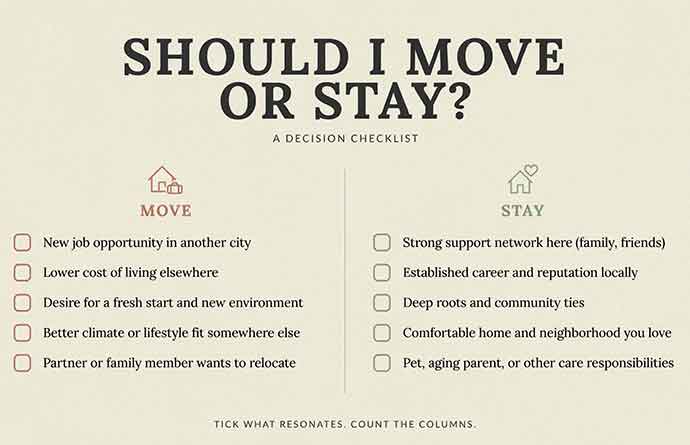
Should I Move-or-Stay Checklist
Staying may make more sense when:
You have a low mortgage rate.
Your assessed value is capped.
A move would trigger reassessment.
You use the local services.
You expect to move again within a few years.
Insurance or HOA costs are higher at the destination.
You qualify for an exemption or appeal.
Your family, work, and healthcare network is difficult to replace.
Moving may make more sense when:
The tax bill is becoming unaffordable on your income.
You no longer need the services you are funding.
Downsizing will reduce several expenses.
The destination offers a much lower total cost of ownership.
You can avoid taking on a large new mortgage.
You plan to remain in the new area long enough to recover moving costs.
The move also improves access to family, healthcare, a good job, or a preferred lifestyle.
Should you Move Because of High Property Taxes?
Moving because of rising property taxes can make sense, but rarely because of the tax rate in itself.
Moving can make sense when:
Your current tax burden is no longer sustainable.
The destination has a lower total cost of ownership, not only a lower tax rate.
You understand how the new home will be assessed.
You will not lose a valuable mortgage or transferable tax benefit.
The long-term savings exceed the cost of moving.
You expect to remain in the new location for many years.
Staying is often the better financial choice when a protected assessment, inexpensive mortgage, useful public services, and local support network outweigh the potential tax savings elsewhere.
Before deciding, compare two complete budgets over at least five and preferably 10 years. Include every housing expense, the cost of the move, and a realistic estimate of future taxes.
You should be looking for the home and community that offer the best long-term balance of affordability, services, stability, and quality of life, not just the lowest property taxes.
You may also like to read: Countries Where You Can Live on $2000 a Month. If the cost of living in the US is becoming unmanageable, maybe it is time to seriously look at moving abroad. In this guide, we look at countries where you can realistically live on $2000 per month.
Frequently Asked Questions
What state has the highest property tax rate?
Based on 2025 rates for owner-occupied housing, New Jersey and Illinois were tied at approximately 1.88%, but actual rates and bills vary significantly within each state.
What state has the lowest property tax rate?
Hawaii had the lowest statewide effective rate in the 2025 comparison at approximately 0.29%, followed by Alabama at 0.37%. Hawaii’s expensive housing means that a low percentage does not necessarily mean a lower bill.
Can property taxes increase when home prices fall?
Yes. Local governments may change tax rates or levies, exemptions may expire, and assessed values may follow a different schedule from current market values. In 2025, the national average rate increased even as ATTOM’s estimated average home value declined slightly.
Will I pay the same property tax as the home’s current owner?
Not necessarily. A sale may trigger reassessment, and the current owner may have exemptions or assessment protections that you cannot inherit. Obtain a new-owner estimate from the local assessor.
Is it better to move to another state or another county?
Sometimes moving to another county, municipality. or school district provides much of the potential tax saving with none of the expenses and stress of an interstate move. Property taxes can vary considerably within the same state.
Are high property taxes worth paying for better schools?
They can be, particularly when good public schools mean you don’t need private tuition; however, a high tax bill does not guarantee school quality. Review the particular district and the services you will actually use.
Should retirees move because of property taxes?
Retirees should compare the tax bill with income, available senior exemptions, healthcare access, insurance, moving costs, and proximity to family. A lower-tax state may be beneficial, but moving can also mean the loss of assessment protections and support networks.
Can I appeal my property taxes?
You can usually appeal the assessment or classification of the bill. Procedures and deadlines vary locally. Strong evidence may include factual errors in the property record, recent comparable sales, or unequal treatment compared with similar homes.
Data and tax rules are current as of July 2026. Property tax laws, exemptions, and local rates change regularly. Verify figures with the relevant assessor or tax authority before making a financial or moving decision.
Good luck in making your decision, and if moving is the right choice for you, then be sure to visit our home moving blog, which is packed with guides to make every aspect of your move easier, cheaper, and safer.
*At MoveAdvisor we will connect you with a professional moving company. Please note that we may not be affiliated with
and you may be speaking with another licensed provider.
We use cookies to optimise your experience.Accept and close or Learn more









Share your thoughts by leaving a comment