1. Miami, Florida. Paradise Has Become Expensive
Miami was attracting remote workers, entrepreneurs, and higher-income households from cities such as New York and Los Angeles.
Florida has no individual state income tax, the weather is warm, Miami has beaches and nightlife, and compared with some of the country’s most expensive coastal cities, it seemed that you could get significantly more for your money.
The problem is lots of people had the same idea.
Miami is now far less affordable, while housing and insurance costs have become major concerns.
Bank of America Institute’s latest migration analysis says Miami continues to have more people heading out while cities including Austin and Denver are still attracting net inflows.
Redfin’s data tells another part of the story. Miami is still attracting relocating homebuyers, but its estimated net inflow from Redfin searches was just 6,576 in Q1 2026, compared with more than 28,000 in 2022, which is a huge change.
There is also another issue that doesn’t get the attention it deserves when people research moving to Florida: climate-related costs.
Redfin found that high-flood-risk counties experienced a net domestic outflow of more than 63,000 people in 2025, with Miami among the flood-prone areas losing the most residents.
If you move to Miami expecting an inexpensive alternative to New York or California, you may be in for a shock.
If you move there because you love Miami and can comfortably afford living there, that is a totally different decision.
Potential relocation regret: You moved for sunshine and lower taxes but underestimated housing, insurance, and everyday living costs.
You may also like to read: Where to Move to Avoid Climate Change. In this guide, we suggest what climatic changes to take into consideration when choosing where to live next.
2. Tampa, Florida. From Move-In Hotspot to Move-Out List
Tampa may be an even better example of how quickly a relocation hotspot can change.
Warm weather, beaches nearby, no state income tax, a growing economy, and housing that appeared affordable compared with New York, California, or South Florida made Tampa Bay an obvious choice for many movers.
And people arrived in droves.
Redfin’s analysis of Census data found that Tampa had a net domestic inflow of around 35,000 people in 2023 but a year later dropped to just over 10,000.
That means Tampa’s net domestic inflow dropped by about 70% in just one year.
Then something else interesting happened: Tampa Bay appeared on PODS’ list of the top move-out markets in 2025 for the first time.
Tampa is not becoming a ghost town, but the revolving door is spinning a lot faster than it used to.
PODS points to rising prices, increasingly limited space, and congestion as some of the problems affecting former boom destinations such as Tampa and Austin.
And this is where researching a move purely on historical information can go badly wrong.
An article called “10 Reasons Tampa Is One of America’s Most Affordable Cities” written several years ago can still rank highly in Google, but that does not mean Tampa offers the same value today.
Potential relocation regret: You moved to Tampa because everybody said it was an affordable Florida city, only to discover that thousands of other people read the same advice before you.
You may also like to read: Rising Property Taxes. In this guide, we find out when it makes sense to stay and when it makes sense to move because of rising property taxes.
3. Orlando, Florida. The Affordable Florida Alternative?
Orlando has jobs, entertainment, warm winters, fairly easy access to beaches, major airports, family attractions, and historically cheaper housing than South Florida.
The metro was where some of America’s biggest population gains were recorded.
Between 2022 and 2023, the Orlando-Kissimmee-Sanford metropolitan area grew by almost 55,000 residents, according to Census Bureau estimates.
But domestic migration has since noticeably dropped.
An analysis of newer Census data reported that Orlando was among the Florida metro areas experiencing net domestic migration losses in 2024.
That is notable because a metro can continue growing overall because of births and international migration while at the same time losing more U.S. residents to other cities and states than it gains from them.
Florida’s domestic migration boom has slowed sharply from its pandemic peak as housing costs, insurance costs, and general affordability have become bigger concerns.
Orlando may therefore be experiencing something that happens to many successful places.
People move somewhere because it offers better value, demand pushes up the cost of living, and eventually, some of the people who moved there for that value start looking somewhere else.
Potential relocation regret: Your decision made financial sense using 2020 or 2021 Orlando prices, but not necessarily today’s.
You may also like to read: The Pros and Cons of Moving to Florida. In this guide, we look at what makes Florida so popular but also the things you should take into consideration before deciding to move there.
4. Atlanta, Georgia. From +17,000 to Negative Migration
Atlanta is possibly the most obvious reversal on this list.
For years, it had nearly everything relocation guides tell you to look for.
- A major employment market.
- A huge international airport.
- Relatively affordable suburbs.
- Warmer weather.
- Big-city amenities without New York or Los Angeles prices.
This attracted huge numbers of people, but then the numbers changed.
According to Redfin’s analysis of Census data, Atlanta recorded a net domestic inflow of roughly 17,000 people in 2023, then in 2024, it recorded a net outflow of nearly 2,000.
That is a very noticeable change of direction.
But Atlanta’s overall metropolitan population can still grow even while domestic migration turns negative, so this should not be seen as a mass exodus.
However, it does suggest that more Americans are questioning whether Atlanta’s advantages still outweigh its disadvantages.
This is a recurring problem with boom cities; people usually discover the advantages before moving, and then they discover the disadvantages after moving.
Traffic, for example, does not look bad when you are viewing houses online.
A longer commute does not seem like a deal breaker when you are comparing a $500,000 Atlanta house with an $850,000 house elsewhere.
But commuting every day for two years in hellish traffic soon changes your priorities.
And there is also far more competition among Southern cities now.
Someone who moved south for affordability does not necessarily have to return to New York or California if Atlanta stops working for them.
They can simply start looking at Chattanooga, Greenville, Huntsville, Knoxville, or one of dozens of the other smaller Southern markets.
Potential relocation regret: Atlanta still provides many big-city advantages, but the bargain is not as obvious as it once was.
You may also like to read: How to Find the Best City for You. In this guide, we suggest things to take into consideration when choosing which city to move to.
5. Austin, Texas. People Keep Moving In, and People Keep Moving Out
Austin is slightly different from the other cities on this list as it is not currently experiencing a straightforward exodus.
In fact, Bank of America Institute still identifies Austin as one of the major metros attracting people. So why include it?
Because Austin demonstrates that high inbound migration does not always mean residents are staying.
Bank of America’s analysis found that Austin has substantial flows in both directions. The cities sending people to Austin are often also among the places people from Austin are heading to.
Austin therefore looks less like a city everybody moves to permanently and more like a very active relocation market.
In some cases, people may discover that the Austin they had heard about is not quite the Austin they find when they get there.
The city’s pandemic-era reputation was built partly around tech jobs, entertainment, lifestyle, and the thought that you could enjoy many big-city advantages without coastal-city prices.
But, as usual, huge demand changed the equation.
PODS highlighted Austin and Tampa as cities where rapid growth eventually contributed to higher prices, reduced space, and worsening congestion.
Austin could still be the perfect city for you, but moving there because somebody told you five years ago that it was a cheap alternative to San Francisco is not enough research.
Potential relocation regret: You moved for the Austin everyone talked about during the boom, rather than the Austin that exists today.
You may also like to read: Moving to Atlanta. In this guide, we look at the pros and cons of moving to Atlanta.
So Why Do People Regret Moving to Boom Cities?
There is a common thread running through almost every city on this list.
- Success changes places.
- People discover a relatively affordable city with good jobs and a great lifestyle.
- Articles get written about it.
- TikTok discovers it.
- Remote workers arrive.
- Investors arrive.
- Developers arrive.
- More people arrive.
Because of that:
- Housing gets more expensive.
- Roads become busier.
- Restaurants and services become more expensive.
- Insurance, taxes, or other household costs rise.
Eventually, the original reason for moving there is gone, which is particularly obvious in former Sun Belt hotspots.
Even Texas and Florida recorded nearly equal inbound and outbound moves in United Van Lines’ 2025 customer data.
People are now searching for the next place that offers affordability, jobs, and the quality of life that yesterday’s boomtowns used to offer.
You may also like to read: Is Your Zip Code Becoming Uninsurable? In this guide, we ask whether you should move home before your home becomes uninsurable or even unsellable.
The Biggest Moving Mistake is Using Old Data
This may be the most useful lesson from all of this; when researching somewhere to move, check the date on everything.
A city guide written in 2019 may be factually correct and still be completely useless for deciding whether to move there in 2026.
- House prices change.
- Rents change.
- Insurance changes.
- Neighborhoods change.
- Traffic changes.
- Job markets change.
- And perhaps most importantly, your own cost of living can be very different from somebody else’s.
The phrase “Texas is cheap” tells you almost nothing; neither does “Florida has no state income tax.”
The question is what your complete financial picture will look like after moving there.
That means checking:
- housing costs
- property taxes
- homeowners or renters insurance
- flood or hurricane insurance where relevant
- utilities
- commuting costs
- childcare
- healthcare
- local salaries
- expected moving costs
- the cost of eventually moving again if it does not work out
That last one is rarely included in relocation budgets, but it should be.
You may also like to read: How to Choose the Best Neighborhood to Move to. Often it is the neighborhood rather than the state or city that is the problem. In this guide, we suggest things to take into consideration when choosing the best neighborhood to move to.
How Can You Avoid Relocation Regret?
If possible, spend time there first, not vacation time, but living it like a local.
- Stay outside the tourist center
- Drive to work during rush hour
- Visit a grocery store.
- Check neighborhoods at night.
- If you have children, drive the school run.
- Look at insurance quotes for actual properties.
- Check what your rent could increase to rather than just what the first year’s rent will be.
- Talk to people who moved there recently rather than somebody who has lived there for 20 years.
And perhaps most importantly, search for reasons not to move somewhere.
If you search “Why should I move to Tampa?”, the internet will tell you. Try searching “Why are people leaving Tampa?” as well, because you will probably learn more.
You may also like to read: What to do When You Regret Moving. In this guide, we look at the different types of moving regret, how to handle that regret, and how to decide if moving again is the right decision.
Does This Mean You Shouldn’t Move to Miami, Tampa, Orlando, Atlanta, or Austin?
No. Every city on this list still attracts new residents for very good reasons, and millions of people are perfectly happy living in them.
The mistake is assuming that because thousands of other people are moving somewhere, it must also be the right place for you.
Population growth is not a quality-of-life review.
Migration numbers do not tell you whether you will like the weather, whether your salary will be enough, whether you will hate the traffic, or whether you will miss the place you left.
Usually, places that become too popular too quickly can create their own problems.
The hottest relocation destination today can become tomorrow’s city that everyone complains has become too expensive and overcrowded.
Which raises an interesting question to research:
Where are people moving to and are still there a decade later?
That may tell you far more about the best places to live.
You may also like to read: The 3% Mortgage Prison. In this guide, we look at whether having a low-rate mortgage is actually costing you money.
Frequently Asked Questions
What cities are people moving out of after previously moving there?
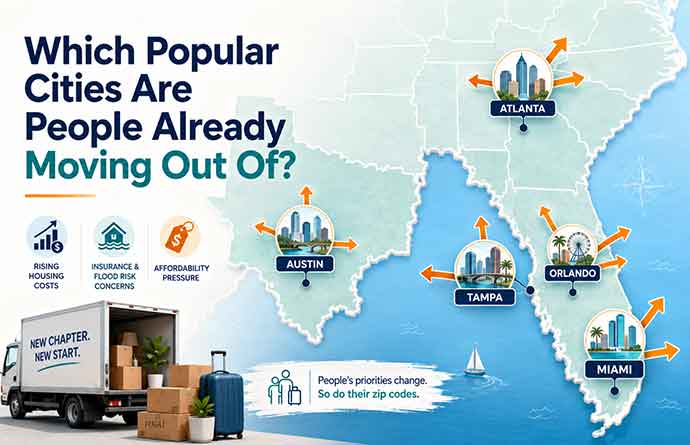
Recent migration data shows significant reversals or weaker domestic migration in former boom destinations including Miami, Tampa, Orlando, and Atlanta. Austin remains a strong destination, but it also experiences substantial outbound migration, making it an example of a high-turnover relocation market.
Are people still moving to Florida?
Yes. Florida continues to attract movers, particularly to smaller and midsized markets, but domestic migration has slowed substantially compared with the pandemic-era boom. Rising housing, insurance, and living costs are increasingly influencing relocation decisions.
Are people leaving Tampa?
People are both moving to and leaving Tampa. However, Tampa’s net domestic migration fell sharply from around 35,000 in 2023 to just over 10,000 in 2024, and Tampa Bay appeared on PODS’ move-out ranking in 2025 for the first time.
Are people leaving Austin?
Austin still attracts more people in some recent datasets, so describing it as an exodus would be misleading. However, Austin experiences significant movement in both directions, meaning many residents leave even while new residents continue arriving.
Why are people leaving popular Sun Belt cities?
Affordability usually appears as a reason. Housing costs have increased substantially in many former relocation hotspots, while Florida residents also face concerns about insurance and climate risk. Congestion and the rising cost of living can soon reduce a city’s appeal.
How do I know whether I will regret moving to a new city?
Research current rather than historical costs, spend ordinary working days in the city before moving if possible, compare local salaries with your total living expenses, get real insurance quotes, test your likely commute, and speak with people who moved there recently. Most importantly, research the reasons people leave the city as carefully as the reasons people move there.
Good luck with your move, and be sure to visit our home moving blog, which is packed with guides to make every aspect of your move easier, cheaper, and safer.
Also Read







Share your thoughts by leaving a comment