When people decide that their cost of living is too high, they often start looking to move hundreds or thousands of miles away.
They usually compare states with no individual income tax, cities with cheaper homes, and areas where property taxes appear lower.
But often a smarter financial move is much closer.
Moving to another neighborhood, a nearby suburb, or a town 30 miles away can sometimes result in many of the same savings as an interstate move.
Sometimes, a local move can leave you financially and emotionally better off because it reduces your housing and living expenses without you needing to give up your job, professional network, family support, or familiarity with the area.
We should be asking: Where gives you the lowest total cost of living whilst keeping the things that matter to you?
Can moving locally lower your cost of living?
A local move can reduce your housing payment, property tax, home insurance, utility bills, HOA fees, transportation expenses, and other costs.
It may not eliminate state income tax, but income tax is only one part of a household budget; housing and transportation are usually a far bigger chunk.
According to the Bureau of Labor Studies, in 2024, the average U.S. household spent approximately $26,266 on housing and $13,318 on transportation. Together, they accounted for just over half of all average household expenditure.
That means a small change in housing or transportation costs can save you more than a reduction in taxes.
Remember also that a local relocation is nearly always cheaper than an interstate move. You are moving your belongings a shorter distance, may be able to move in stages, and are unlikely to need flights, hotels, storage, or temporary accommodation.
Cost-of-living comparisons often use state averages, which are useful for plotting trends, but families do not live in state averages; they live at specific addresses.
Two homes in the same metropolitan area may have very different:
Affordability can change significantly over a fairly short distance.
A lower cost of living may therefore be achievable without leaving your current employer, friends, relatives, or a place where you are otherwise happy.
Local moves are more common than interstate moves
Moving locally is not an unusual compromise; it is the most common type of home move.
Census Bureau data show that 8.9% of Americans moved to another residence within the same state in 2024, compared with 2.1% who moved to another state.
People move locally for more space, a better neighborhood, a shorter commute, or a change in housing needs, but a local move can also be a sound financial strategy.
You may also like to read: How to Choose a New Neighborhood. In this guide, we suggest things to take into consideration when choosing a new neighborhood to move to.
1. Housing savings can be found a few miles away
Housing is the first place most people should look.
The median monthly cost for U.S. homeowners with a mortgage reached $2,035 in 2024, according to the Census Bureau.
A difference of several hundred dollars between two nearby housing markets can therefore produce some serious savings.
Prices and rents can change when you cross:
A school-district boundary.
A city limit.
A county line.
A transit corridor.
A highway.
A neighborhood boundary.
The edge of a popular downtown area.
A household paying $3,000 a month in a desirable central neighborhood may find a comparable home for $2,400 in an established town 20 minutes away.
Alternatively, moving closer to work could justify choosing a more expensive home because you would need fewer vehicles, less fuel, or no paid parking.
The lowest-priced home is not always the most affordable home; it is the combined cost of housing and daily life that matters.
2. Property tax is assigned locally
Moving to a low-property-tax state sounds appealing, but state averages hide local differences.
Property taxes are generally imposed by local governments. Rates and bills can vary by county, municipality, township, school district, and special taxing district.
This makes state-level property tax comparisons difficult and sometimes misleading.
Two similarly priced homes in neighboring towns may produce very different annual tax bills.
Suppose one home has an annual property tax bill of $11,000 while a comparable home in the next municipality is taxed at $7,500. That is a difference of $3,500 a year, or approximately $292 a month.
Over ten years, before allowing for future increases, that difference would total $35,000.
You do not need to move from New Jersey to Tennessee to benefit from a lower property tax bill. In some places, you may only need to cross a municipal or school-district boundary.
However, lower property tax can affect public services, school funding, road maintenance, or emergency coverage, so you need to compare both the tax bill and what the tax supports.
You may also like to read: The Rising Cost of Property Tax. In this guide, we look at why property tax is rising and what you can do about it.
3. Home insurance can change between neighborhoods
Home insurance is frequently seen as a state-level problem, particularly in areas prone to hurricanes, wildfire, hail, or severe storms.
Yet insurance risk is also very local.
The National Association of Insurance Commissioners explains that homeowners’ insurance pricing can be affected by the neighborhood in which a property is located, including crime, access to fire protection, the water supply, and the value and characteristics of the home.
Flood exposure can vary even more. FEMA maps identify flood risk by community and property location, allowing buyers to investigate whether an individual address is in or near a higher-risk area.
A move of only a few miles might take you:
Farther from the coast.
Outside a designated flood zone.
Away from a wildfire interface.
Closer to a fire station or hydrant.
Into a newer home built to stronger standards.
Away from an area with frequent theft or claims.
Into a home with a lower rebuilding cost.
However, that does not guarantee a lower premium.
Insurers use their own rating models, and the property itself matters, so the only way to know for sure is to request insurance quotes for the exact addresses you are considering before making an offer.
You cannot assume that two homes in the same city will cost the same to insure.
4. A shorter commute can be worth more than a tax reduction
Many people move farther from a city to obtain a cheaper home. They reduce their mortgage or rent but increase their transportation costs.
This can create the illusion of saving money.
A long commute may add:
Fuel.
Tolls.
Parking.
Vehicle depreciation.
Maintenance and repairs.
Insurance mileage.
The cost of a second vehicle.
Unpaid time spent traveling.
Transportation accounted for an average of 17% of U.S. household spending in 2024. That makes commuting one of the most important considerations in any relocation decision.
You could be better off moving across the city to a transit-connected neighborhood than moving to a cheaper state where two vehicles are essential.
The reverse may also be true. A remote worker could move to a nearby small town, keep the same salary, and eliminate much of the housing premium associated with living close to an office.
Calculate transportation and housing together; don’t evaluate the new rent or mortgage on its own.
5. Local taxes and charges may also change
State income tax gets all the attention because it is easy to compare, but it is not the only tax you need to think about.
Depending on where you live, crossing a local boundary may change:
Municipal income or wage taxes.
County income taxes.
Local sales tax.
Property tax.
Vehicle registration charges.
School-district taxes.
Utility taxes.
Waste collection fees.
Parking permits.
Special assessments.
Local income taxes are imposed in thousands of U.S. cities, counties, school districts, and other jurisdictions, although their structure varies considerably.
Local sales tax rates can also differ between cities and counties within the same state.
These costs may appear small individually, but recurring charges soon add up.
Before moving, obtain a sample property tax bill, utility estimate, and local tax information for the specific address; do not rely just on statewide tax rankings.
6. You may be able to keep the same income
This is one of the biggest advantages of moving locally.
A move to a lower-cost state may also involve:
Accepting a lower salary.
Changing employers.
Losing seniority.
Giving up clients.
Rebuilding a professional network.
Paying for new licenses or certifications.
Experiencing a period without income.
A local move can allow you to reduce your expenses while keeping the same job and salary.
This could mean that your local costs go down while your income remains the same.
A 10% reduction in expenses with no reduction in income can be worth more than a move to a cheaper state that also cuts your salary by 15%.
Remote workers have even more flexibility. They may be able to move from an expensive urban neighborhood to a lower-cost town in the same region without changing employers, time zones, airports, or access to family.
7. Staying near family can have a real financial value
Family and community are often described as emotional reasons to remain nearby, but they can also have financial value.
Living close to relatives or trusted friends may provide access to:
Occasional childcare.
School pickups.
Help during illness.
Pet care.
Elderly care.
Shared transportation.
Emergency accommodation.
Informal home maintenance support.
Moving across the country may mean that you have to replace some of that informal support with paid services.
A household that saves $500 a month on housing but begins paying $1,200 a month for childcare makes no financial sense.
This is why a realistic cost-of-living comparison must include the services and support you would lose, not only the bills you expect to reduce.
8. A local move usually has lower upfront risk
An interstate move can require a large financial commitment before you know whether the new location will work for you.
Potential costs include:
Long-distance moving services.
Vehicle shipping.
Flights and hotels.
Temporary housing.
Storage.
Travel for home searches.
Time away from work.
Replacing items that are impractical to transport.
Higher deposits.
Delays between leaving one home and entering another.
Local moving companies typically charge based on time and labor, while long-distance costs are charged by distance, shipment size, and transportation requirements.
A local move may also allow you to move smaller items yourself or transfer things over several days.
That lower upfront cost shortens the time needed for monthly savings to repay the cost of moving.
It also reduces the consequences if you decide that the new area is not right for you.
You may also like to read: How to Choose the Best Place to Move to. In this guide, we suggest things to take into consideration when choosing which city to move to.
Local move versus interstate move
Financial consideration
Local move
Interstate move
Housing savings
Possible across neighborhoods and nearby towns
Possible, especially between major markets
Property tax savings
Often possible across local jurisdictions
Possible, but state averages may hide local variation
Home insurance savings
Possible by changing property type or local risk
Possible, but a cheaper state can still contain expensive insurance markets
State income tax
Usually unchanged
May increase, decrease, or disappear
Local income and sales taxes
May change
Likely to change
Employment income
More likely to remain stable
May require a new job or salary adjustment
Commuting costs
Can rise or fall significantly
May change completely
Family support
More likely to remain available
More likely to be disrupted
Moving cost
Usually lower
Usually higher
Ability to test the area
Easier
More difficult and expensive
An example local-move calculation
Consider a family that currently spends:
$2,600 on its mortgage.
$700 on property tax.
$350 on home and flood insurance.
$300 on utilities.
$1,100 on two vehicles, commuting, tolls, and parking.
$150 in HOA fees.
Its total location-related spending is $5,200 a month.
The family finds a smaller home in a nearby municipality with:
A $2,300 mortgage.
$450 in property tax.
$220 in insurance.
$260 in utilities.
$600 in transportation costs.
No HOA fee.
Its new total is $3,830 a month.
That is a saving of $1,370 a month, or $16,440 a year.
Even if the move costs $4,500, the family recovers that expense in a little over three months.
This is only an example, but it shows why the complete calculation is important.
The largest saving does not come from one big tax advantage, it comes from several small improvements added together.
The local relocation formula
Before comparing destinations, calculate the following for your current home and each possible new address:
Total monthly location cost =
Housing payment
Property tax
Home or renters insurance
Flood, wind, or earthquake insurance
HOA and special assessments
Utilities
Transportation
Parking and tolls
Local taxes and fees
Childcare changes
Home maintenance
Lost support or services
Monthly share of moving costs
To calculate the monthly share of moving costs, divide the estimated cost of moving by the number of months you expect to stay.
For example, if the move costs $4,800 and you expect to remain for four years:
$4,800 ÷ 48 months = $100 per month
Adding that amount ensures the upfront expense is included in your comparison.
Compare Individual Properties
Once you identify a suitable town or neighborhood, compare individual properties carefully.
A cheaper house may cost more overall if it has:
An old roof that increases insurance costs.
Poor insulation.
Electric resistance heating.
High HOA fees.
A long drive to work.
Large maintenance requirements.
Flood exposure.
An upcoming special assessment.
No access to public transportation.
High property taxes following reassessment.
Conversely, a slightly more expensive house may be cheaper to run because it is newer, more energy-efficient, and closer to work.
Request real numbers wherever possible, as insurance quotes, tax records, utility histories, and commute tests are more useful than generic cost-of-living figures.
You may also like to read: Is Your Home Becoming Uninsurable? The cost of home insurance is rising fast, and in some states homes are becoming uninsurable. In this guide, we ask: Should you move before your home is harder to sell?
When moving locally may be the better choice
A local move is worth researching when:
Your job is tied to the region. You can keep your salary, benefits, and career progress while reducing housing costs.
You live in an expensive neighborhood but not an expensive region. A nearby town may offer similar amenities without the premium attached to your current ZIP code.
Your property tax or insurance has become unaffordable. A different municipality, risk zone, or type of home may reduce both.
Your commute is expensive. Moving closer to work or reliable transit could cut vehicle and parking costs.
You need less space. Downsizing locally can release equity or reduce rent while keeping your social connections.
You need family support nearby. You can improve your finances without losing valuable family support.
You want to test a lower-cost lifestyle. Renting in a nearby town for a year is less upheaval than relocating across the country.
When an interstate move may be better
A local move is not always the answer. Crossing state lines may still make sense when you want to:
Eliminate or reduce state income tax.
Move to a fundamentally different climate.
Access a stronger employment market.
Benefit from different retirement-tax rules.
Move closer to distant family.
Leave an area with widespread insurance or housing problems.
Access different laws, public benefits, or education systems.
Make a major lifestyle change rather than simply reduce expenses.
The important point is that an interstate move should be the result of a complete comparison, not an automatic response to high living costs.
A state with no individual income tax is not necessarily a low-cost state. Higher housing, insurance, property tax, transportation, or consumption taxes can offset the income-tax benefit.
Questions to ask before choosing a nearby area
Before signing a lease or making an offer, find answers to these questions:
What will the actual property tax bill be after purchase and reassessment?
Can an insurer provide a quote for this exact address?
Is the property in or near a flood, wildfire, or storm-risk area?
How much will utilities cost throughout the year?
Are there HOA fees, special assessments, or local service charges?
How will the move change the number of vehicles we need?
What will the commute be like during peak hours?
Will childcare, elder care, or school transportation change?
Can we keep the same jobs and income?
Which services or support will we lose by moving?
How much will the move itself cost?
How long will it take for the monthly savings to repay that cost?
A local move should improve your total household budget, not just one line within it.
You may also like to read: The 3% Mortgage Trap. Those with a 3% mortgage may think it is financial suicide to move home, but in this guide, we explain why that 3% rate may actually be costing you more.
The best financial move is often the shortest one
Moving to another state can improve your finances, but it is not the only way to make your money go further.
Housing costs, property taxes, insurance premiums, transportation expenses, and municipal charges can change significantly within the same metropolitan area.
You may be able to get those savings while keeping your income, employment, family support, and familiarity within the region, which can make a local move more financially useful than a long-distance relocation.
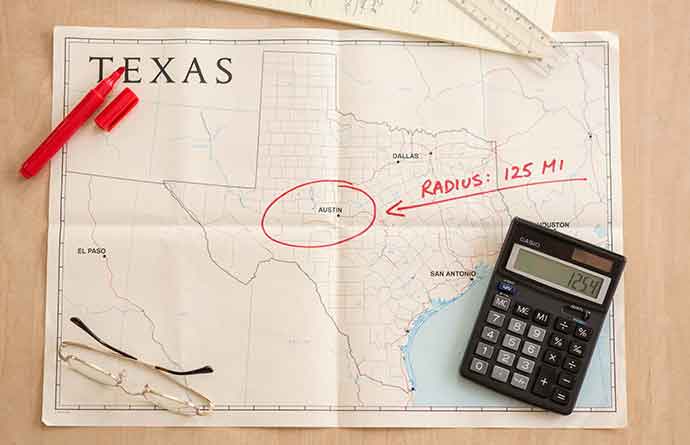
Before searching the entire country, zoom in on the map.
Compare nearby towns, municipal boundaries, insurance-risk areas, commuting routes, and individual properties.
Calculate the complete cost of living at each address.
Your more affordable life may not be three states away; it may be three exits down the highway.
You may also like to read: I want to Move, but my Partner Says No. In this guide, we seek to find compromises to overcome this common home moving dilemma.
Frequently asked questions
Is moving locally cheaper than moving out of state?
The physical move is usually cheaper because the distance and transportation costs are lower. A local move avoids flights, hotels, vehicle shipping, temporary accommodation, and long-distance storage. The exact difference depends on the size of the household, the distance, and the services required.
Can property taxes change within the same city or metropolitan area?
Property taxes may be affected by county, municipal, township, school-district, and special-district boundaries. Two similarly priced homes in nearby communities can have substantially different tax bills.
Can moving across town lower home insurance?
Insurance costs may differ because of flood exposure, wildfire risk, crime, fire protection, rebuilding costs, and characteristics of the individual property. Obtain quotes for each exact address before deciding.
Is moving to a state with no income tax always cheaper?
No. The income-tax savings can be offset by housing, property tax, sales tax, insurance, transportation, and other expenses. Compare your complete household budget rather than one tax category.
How far should I move to lower my cost of living?
There is no minimum distance. Savings may appear when you cross a neighborhood, school-district, municipal, or county boundary. Search outward gradually and stop when the financial improvement is large enough to justify moving.
Should I move farther away to buy a cheaper house?
Only after calculating the added transportation cost. A lower mortgage can be canceled out by fuel, tolls, parking, vehicle depreciation, maintenance, and the need for another car.
How do I know whether a local move is financially worthwhile?
Add all housing, tax, insurance, utility, transportation, childcare, and maintenance costs for both locations. Include the cost of moving, then calculate how many months of savings would be needed to recover it. Also consider changes in income and unpaid family support.
Good luck with your decision, and if you do decide to move, be sure to check out our home moving blog, which is packed with city and state guides, as well as information to make every aspect of your move easier, cheaper, and safer.
*At MoveAdvisor we will connect you with a professional moving company. Please note that we may not be affiliated with
and you may be speaking with another licensed provider.
We use cookies to optimise your experience.Accept and close or Learn more













Share your thoughts by leaving a comment