Americans Are Staying Put Longer
The typical U.S. homeowner now stays in the same home for around 12 years, according to Redfin.
Homeowners staying at the same address peaked at 13.4 years in 2020 and remains almost twice as long as it was in 2005.
Some of that is perfectly understandable.
- People like their homes and neighborhoods.
- Friends live nearby.
- Children are settled in school.
- Moving is expensive, disruptive, and stressful.
But today’s market includes a compelling financial reason to stay.
Millions of Americans bought or refinanced when mortgage rates were exceptionally low.
For them, selling does not just mean giving up a house. It can mean giving up financing they may never be able to replace.
As of September 17, 2026, Freddie Mac put the average rate on a 30-year fixed mortgage at 6.95%.
For somebody with a mortgage close to 3%, that gap can sometimes make the moving decision for you.
A homeowner may want another bedroom, a smaller house, a different state, or a home closer to family, yet it always comes down to the same question: what happens to my mortgage?
Economists call it mortgage lock-in.
For the individual homeowner, staying can be completely rational.
Multiply that same calculation across millions of households, however, and homes stop circulating.
For how that decision can affect individual households – the jobs, family ties, and life choices that can be constrained by staying, read The Homeownership Trap.
Here, the question is what happens to the market when millions of households reach the same conclusion.
Mortgage Lock-In Freezes Both Sides of the Market
It is easy to think of mortgage lock-in only as a supply problem: homeowners do not want to sell, so fewer homes come onto the market.
That may be the case, but it is only half of what happens.
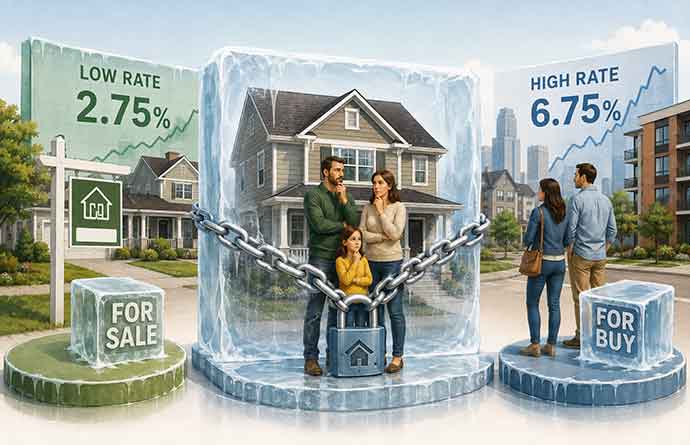
The same homeowner who does not sell usually does not buy another home either.
Research from the National Bureau of Economic Research found that mortgage lock-in reduces both housing supply and housing demand. Owners remain outside the market as sellers, but they also remain outside it as buyers.
Mortgage lock-in does not simply remove a seller; it removes that same household as a buyer.
That helps explain why a housing market can feel strangely quiet even when prices remain high, and buyers complain about limited choice.
The same NBER research points to the roughly 40% decline in U.S. existing-home sales between 2022 and 2024 as evidence of how dramatically turnover slowed.
Housing markets rely heavily on existing homes changing hands.
A home does not have to be newly built to become available to a new household, but it does have to reach the market.
That distinction, between housing stock and housing circulation, is central to today’s gridlock.
Low-rate mortgages often stop people from moving home. But is the 3% Mortgage Trap costing them more than they think?
The Missing Downsizers
One of the most obvious bottlenecks appears among homeowners who might once have moved down the housing ladder.
In theory, downsizing should be straightforward.
- A couple buys a larger home while raising a family.
- The children eventually leave.
- The couple sells, moves into something smaller, and a younger family buys the larger property.
Except the financial logic behind that move is now much weaker.
The NBER study found that mortgage lock-in disproportionately reduces moves down the housing ladder. The researchers describe these households as ‘missing downsizers.’
The problem is, smaller does not necessarily mean cheaper anymore.
Selling can mean today’s prices, today’s borrowing costs, transaction fees, moving expenses, taxes, insurance, and possibly renovation costs.
A property with fewer bedrooms can still leave the owner financially worse off.
There is a second problem: the type of housing many downsizers actually want is not always available where they want to live.
A smaller single-story property, a condo with an elevator, or a lower-maintenance home near friends and grandchildren can be difficult to find.
So the theoretically obvious move never happens, and the larger house never reaches the market.
Who Actually Owns America’s Larger Homes?
A 2026 Redfin analysis using 2024 Census data shows how unusual the distribution of larger homes has become:
• Baby boomers living in households containing only one or two adults own 28% of America’s homes with three or more bedrooms.
• Millennial families with children own just 16%.
• Boomer households containing three or more adults own another 7%.
Those numbers could move us towards an easy but misleading conclusion: Older Americans have the large houses. Younger families need the large houses. So older Americans should move.
But that’s not how it works, nor should it. People need good reasons to move.
If remaining in a large, familiar home with a tiny mortgage payment is cheaper and more comfortable than moving into a smaller property at today’s costs, staying is a perfectly sound decision.
Housing gridlock is not the result of millions of people making bad housing decisions.
It is what can happen when millions of individually rational decisions collectively reduce mobility.
The Empty Nest Isn’t Always Empty
There is another reason to be careful with the idea that large homes are simply ‘underused.’ What looks oversized from the outside may no longer be oversized at all.
In 2024, 22% of Americans lived in multigenerational households, according to the Pew Research Center, up from 13% in 1970.
• Grandparents, parents, and children may share one home.
• An elderly parent may move in with an adult son or daughter.
• Adult children may remain at home longer.
• Children who left years ago may return when housing, childcare, or other living costs become difficult to absorb.
So that four-bedroom suburban home that appears far too large for two retirees may contain five people again.
Redfin’s data is especially interesting in that context: another 7% of America’s large homes are owned by boomer households containing three or more adults.
Some of those households may include adult children or other relatives.
What looks from the outside like a missed opportunity to downsize may therefore be one household solving a housing need that would otherwise appear somewhere else.
America Needs More Homes, and More Circulation
Housing debates often focus on the total number of homes, which is understandable.
More housing supply is essential in markets where too many households are competing for too few suitable homes.
But the number of homes that exist is not the same thing as the number of homes actually available to the people who need them.
A functioning market requires both stock and circulation.
- A three-bedroom house in the wrong city does not solve the problem of a family looking for a three-bedroom house near their children’s school.
- A downtown condo does not automatically solve the needs of a retiree who wants a quiet, accessible home near grandchildren.
- A luxury apartment does not solve the problem of a renter who needs something affordable.
The question is not just how many homes exist. It is whether the right homes are becoming available in the right places, at the right prices, and at the right time.
When turnover slows across several parts of the ladder at once, competition becomes concentrated around the relatively small number of suitable homes that do reach the market.
The missing home may not always be the one that has yet to be built. Sometimes it is the home that never came onto the market.
Why ‘Nobody Is Moving’ Matters
Staying put should be a personal decision. Nobody should move simply because somebody else would like their house.
But when millions of households make similar choices in response to the same incentives, those individual decisions become a market force.
A low mortgage rate can be excellent for the homeowner who has it, while millions of low-rate mortgages can reduce the number of homes reaching the market.
A large family home may work well for the older couple living there, while millions of larger homes remaining outside the market can leave growing families with fewer opportunities to move up.
An adult child staying with parents may be the smartest financial or family decision available, while the rise in multigenerational living can change household demand elsewhere.
None of those choices are wrong.
Together, they help explain why the housing ladder can stagnate even when every household involved is making rational decisions.
What Could Get the Housing Ladder Moving Again?
There is unlikely to be one dramatic moment when the entire market suddenly unfreezes.
Housing changes slowly, and the forces behind today’s gridlock are not all controlled by the same lever.
Mortgage rates matter. A smaller gap between an owner’s existing mortgage and a new loan would make moving less financially painful for some households.
Prices matter too. A household cannot move if the next home is beyond reach even before financing is considered.
But the mix of new housing may matter just as much as the number of homes built.
Downsizing only works when suitable smaller, accessible, and lower-maintenance homes exist in the communities where older owners actually want to stay.
Growing families need family-sized homes.
First-time buyers need realistically priced homes.
Renters need affordable alternatives when a purchase is not possible.
That suggests a useful question for housing policy and development: not only ‘How many homes can we add?’ but ‘Which new homes are most likely to unlock movement elsewhere in the market?’
A new home can create more than one housing opportunity if the household that moves into it releases another useful home behind them.
Conversely, a home built for people already well supplied in a local market may add less movement than the numbers suggest.
Financing needs looking at closely too.
Ideas that reduce the penalty for moving, whether through lower rates, more flexible financing structures, or other ways of reducing transaction friction, are worth evaluating not only for the buyer they help directly, but for the chain of moves they might release.
The goal is not to persuade people to move when they do not want to.
It is to make sure people who do want or need to move are not prevented from doing so by a housing system that makes staying the only sensible option.
The Housing Market Is Not a Collection of Isolated Houses
Just 11.8% of Americans moved to a different residence in 2024, down from 12.1% in 2023, according to the U.S. Census Bureau.
That annual change is small on its own, but it is part of a much larger pattern: homeowners are staying in their homes longer, existing-home turnover has slowed sharply, and several rungs of the housing ladder are struggling to move at the same time.
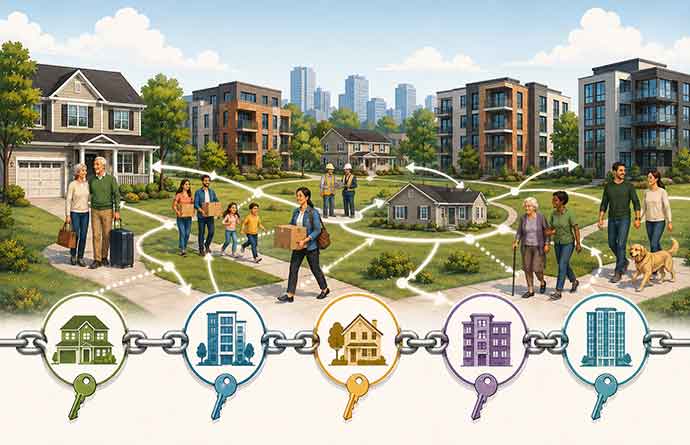
The housing market is not a collection of isolated houses. It is a chain.
For decades, much of the market’s effective supply came not from creating a brand-new house for every person who wanted to move, but from existing homes repeatedly changing hands.
- When that circulation slows, the retiree wonders why downsizing makes so little financial sense.
- The growing family wonders why there are so few larger homes.
- The first-time buyer wonders where the starter homes went.
- The renter wonders why something affordable never seems to come up.
They appear to have different problems, but they may be experiencing different parts of the same one.
America needs more homes. It also needs the homes it already has to be able to move through the market.
Until both problems improve, the housing ladder will remain harder to climb, not only because there are too few rungs, but because too few people can move from one to the next.
Also Read















Share your thoughts by leaving a comment