Does U-Haul Insurance Cover a Stolen Truck?
First, one clarification: U-Haul generally refers to Safemove and Safemove Plus as protection plans, and U-Haul notes that these products are not themselves liability insurance, although parts of the protection packages involve insurance coverage.
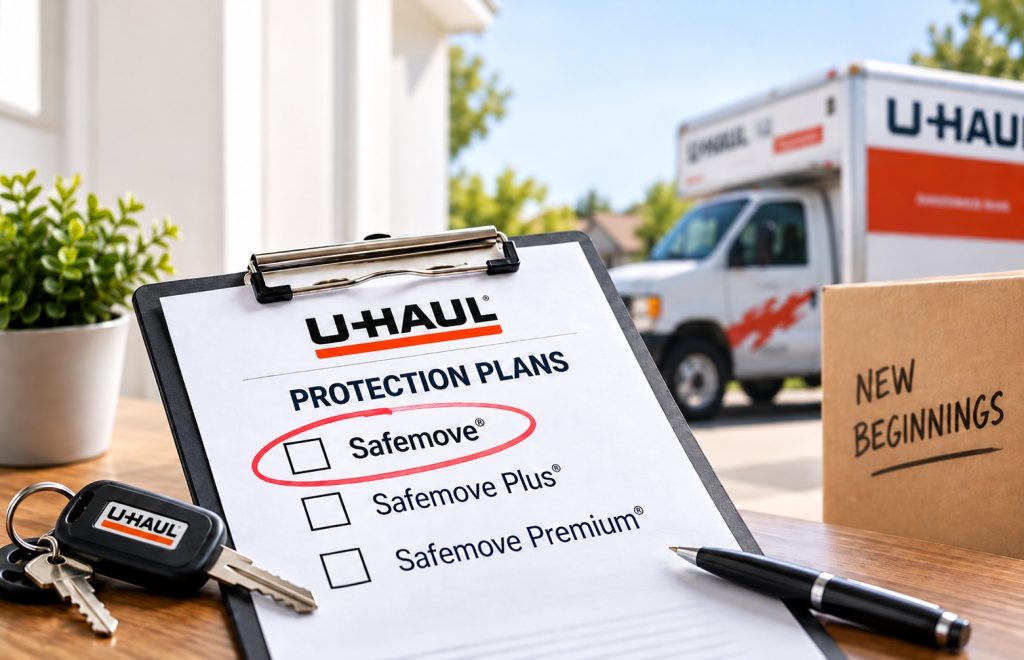
For a rental truck, U-Haul currently offers two main options: Safemove and Safemove Plus.
Safemove includes a damage waiver, cargo protection, and medical/life protection.
Safemove Plus adds supplemental liability protection and broader protection for damage to the rental truck. Availability varies by state.
When it comes specifically to theft, U-Haul states that its applicable protection plans cover theft of the rented U-Haul equipment if neglect did not play a role in its disappearance.
That wording is important.
Leaving the truck unlocked, leaving the engine running while you go inside a convenience store, or doing something else that could reasonably be considered negligent could complicate a claim.
If you declined U-Haul’s protection, don’t simply assume your regular car insurance will take care of the truck.
Personal auto policies frequently exclude large rental trucks or impose vehicle-size or weight restrictions. Both U-Haul and major insurers warn customers to verify coverage before renting.
That means that the insurance that covers your Toyota in the driveway does not necessarily cover the 26-foot box truck carrying your household items across the country.
But What About Everything Inside the U-Haul?
This is the part that catches people out.
Safemove includes something called Cargo Protection, which sounds as though it should protect your possessions.
But cargo protection is not the same thing as theft protection.
U-Haul says its cargo protection covers qualifying loss or damage resulting from events such as a collision, fire, windstorm, or overturn of the rental truck.
Its current coverage information specifically says that theft of cargo is not covered.
That’s really important.
Imagine two identical U-Hauls containing identical belongings.
One overturns on the interstate and destroys the furniture.
The other disappears from a hotel parking lot overnight.
The applicable coverage can be very different even though the financial loss to the family may be similar.
U-Haul also states that it is not responsible for theft of property left in a rental truck or trailer.
So if somebody drives away with the truck, don’t expect the rental company’s cargo protection automatically to write you a check for everything that was inside.
Will Homeowners Insurance Cover Belongings Stolen From a U-Haul?
Possibly.
This is where your own homeowners insurance can become far more important than the protection you bought with the truck.
Standard homeowners policies commonly include personal-property protection against theft, including at least some coverage for property away from the insured home.
The Insurance Information Institute notes that personal belongings can be covered off-premises, although some insurers limit how much they’ll pay for property away from home.
Moving introduces another complication.
State Farm notes that some homeowners policies cover possessions whether they’re in the house or a moving truck, while other policies can restrict coverage once property leaves the residence. It specifically recommends checking coverage for property in transit before moving.
So don’t ask your insurance company, “Does my homeowners policy cover theft?”
The answer will probably be yes.
Ask:
“If all of my household belongings are inside a rental moving truck during an interstate move and the entire truck is stolen overnight, how much of that loss would my policy cover?”
That’s a much more important question to get answered.
Also ask whether the coverage is based on replacement cost or actual cash value.
If a five-year-old television cost $1,500 when you bought it, replacement-cost coverage may work very differently from a policy paying its depreciated value today.
What If You’re a Renter?
Renters insurance can be just as important during a DIY move.
Most renters policies include some form of off-premises protection.
The Insurance Information Institute gives the example of property stolen from a vehicle being covered, but also warns that insurers may limit reimbursement for belongings away from the insured residence.
One traditional example is an off-premises limit of 10% of total personal-property coverage, although actual policy terms vary.
Progressive similarly states that renters insurance may cover belongings stolen from a vehicle, in storage, or while traveling, subject to the policy’s coverage limits and deductible.
That difference can become enormous during a move.
Suppose your renters policy provides $40,000 of personal-property coverage but limits certain off-premises losses to 10%.
You might assume you have $40,000 protecting the truck.
Your usable limit could instead be $4,000.
Don’t use that example as a rule, as policies differ substantially, but use it as a good reason to check.
And check before you cancel your old renters policy.
A move creates an awkward transition period in which you’re leaving one residence but may not yet have fully occupied another.
Confirm with your insurer exactly when your old coverage ends, when your new coverage begins, and how your possessions are protected while they’re between addresses.
Your $50,000 Household May Not Produce a $50,000 Insurance Check
Another mistake is adding up everything inside your home and assuming that’s what an insurer would reimburse after a theft.
Insurance claims rarely work like that.
Your deductible comes first. Then there may be an off-premises limit. Certain categories of property can have their own sublimits. Your settlement can depend on whether your policy provides actual cash value or replacement cost coverage.
Jewelry, watches, art, collectibles, firearms, cash, and some other high-value property can have particularly restrictive limits unless you’ve purchased additional coverage.
There’s also the problem of proving what you owned.
It’s easy to say: “We had everything in there.”
It’s much harder to remember the brand, model, approximate purchase date, and value of every television, laptop, power tool, appliance, jacket, bicycle, bed, and piece of furniture in a three-bedroom house.
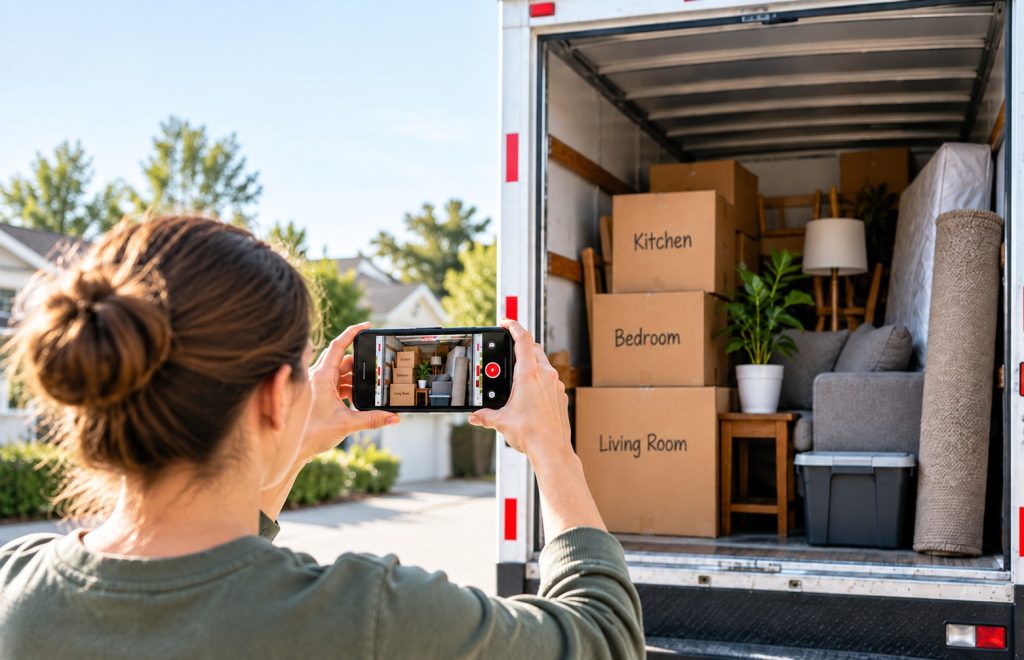
That’s why the boring five-minute video you record before closing the truck door could become one of the most valuable videos on your phone.
U-Haul recommends creating an inventory and uploading photographs of possessions before a move.
You may also like to read: Moving Insurance Explained. Being underinsured is the number one home moving mistake. This guide explains all you need to know about insuring your stuff during a home move.
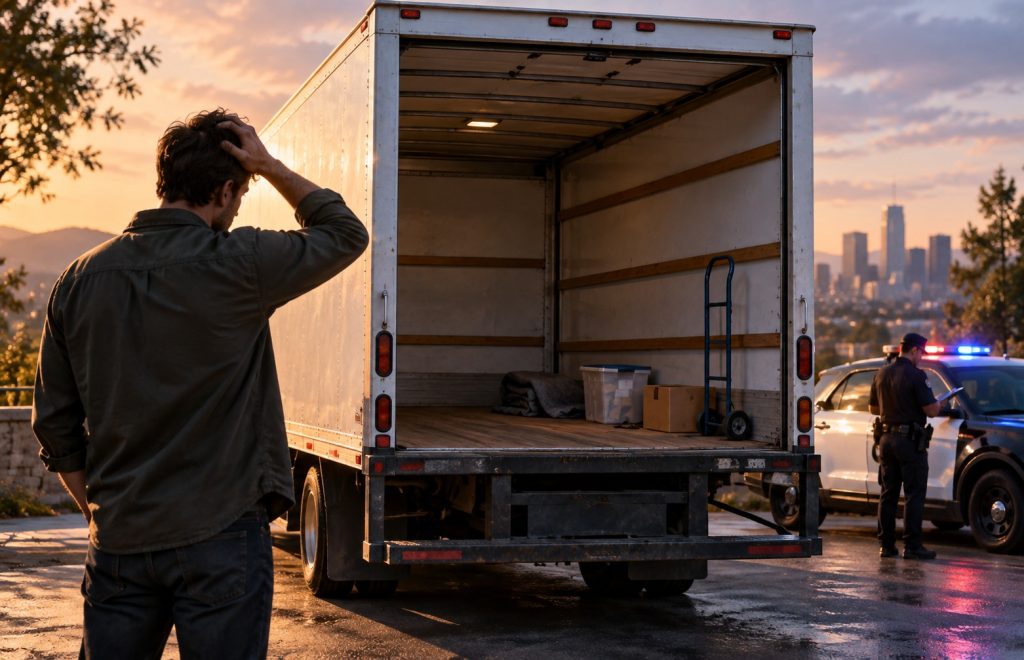
Speed matters.
If you walk outside and the truck isn’t where you left it, don’t spend an hour wondering whether it was towed or driving through nearby streets looking for it.
In this order:
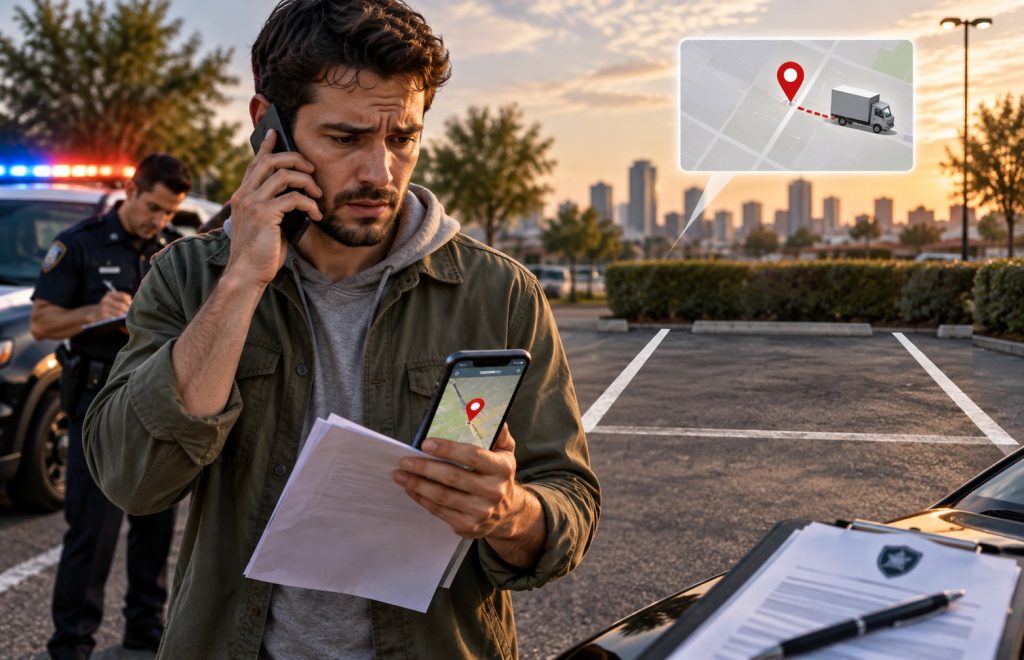
- Call the police immediately. Give them the truck’s license plate, rental-truck number if available, make/model, last known location, and approximate time it disappeared. Get a police report or incident number.
- Contact U-Haul. U-Haul directs customers dealing with stolen equipment to its Equipment Recovery/Roadside Assistance operation at 1-800-528-0355.
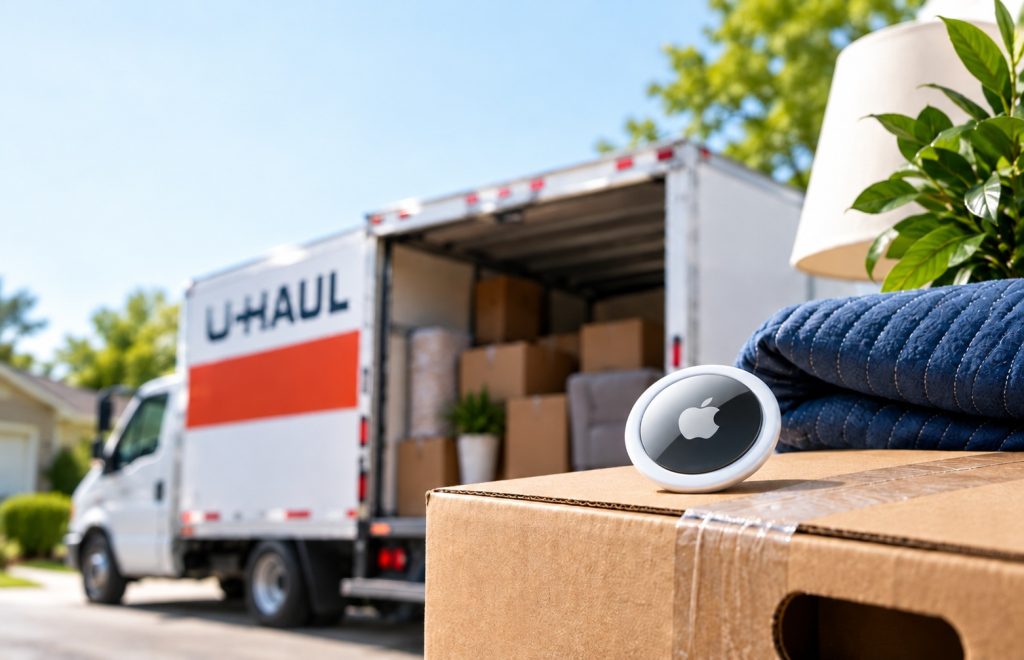
- Check any trackers you own. An AirTag, compatible Android tracker, iPad, laptop, or other connected device inside the load may provide a location. Apple Find My, for example, can show the current or last known location of a registered item. Give useful location information to law enforcement rather than trying to recover the truck yourself.
- Preserve surveillance footage immediately. If you were at a hotel, apartment complex, storage facility, or store, ask management to preserve recordings from every relevant camera. Don’t assume footage will remain available indefinitely.
- Call your homeowners or renters insurer. Tell them the loss happened while your belongings were in transit during a move and ask exactly what documentation they require.
- Start reconstructing your inventory. Use photographs of your old home, packing pictures, receipts, online shopping histories, credit-card statements, serial numbers, and videos.
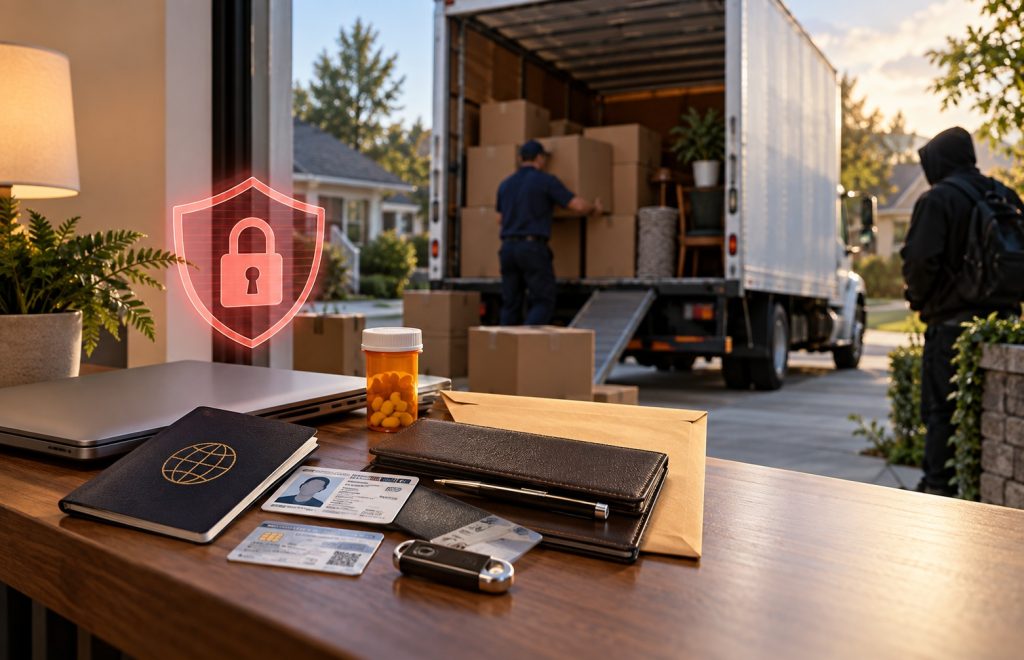
- Protect your identity. If passports, Social Security cards, checks, tax returns, or financial records were inside the truck, treat those as a separate problem rather than just another stolen box.
The police report is particularly important.
Insurers commonly require documentation of theft, and the Insurance Information Institute recommends reporting a theft promptly and keeping the police-report information for your claim.
What If You Have an AirTag or Other Tracker Inside the Truck?
This can make a real difference, but you still need to call the police.
In the 2026 Utah-to-Florida case, location information from an iPad reportedly helped police locate suspects after the couple’s U-Haul was stolen in Albuquerque. Unfortunately, most of the belongings had already been removed by the time the case progressed.
Apple’s Find My network can display the current or most recently detected location of an AirTag or compatible device. Google offers similar functionality through Find Hub for supported tracker tags.
A tracker therefore may help establish where your property went.
Take screenshots, note timestamps, and give the information to law enforcement.
And don’t put your only tracker somewhere obvious.
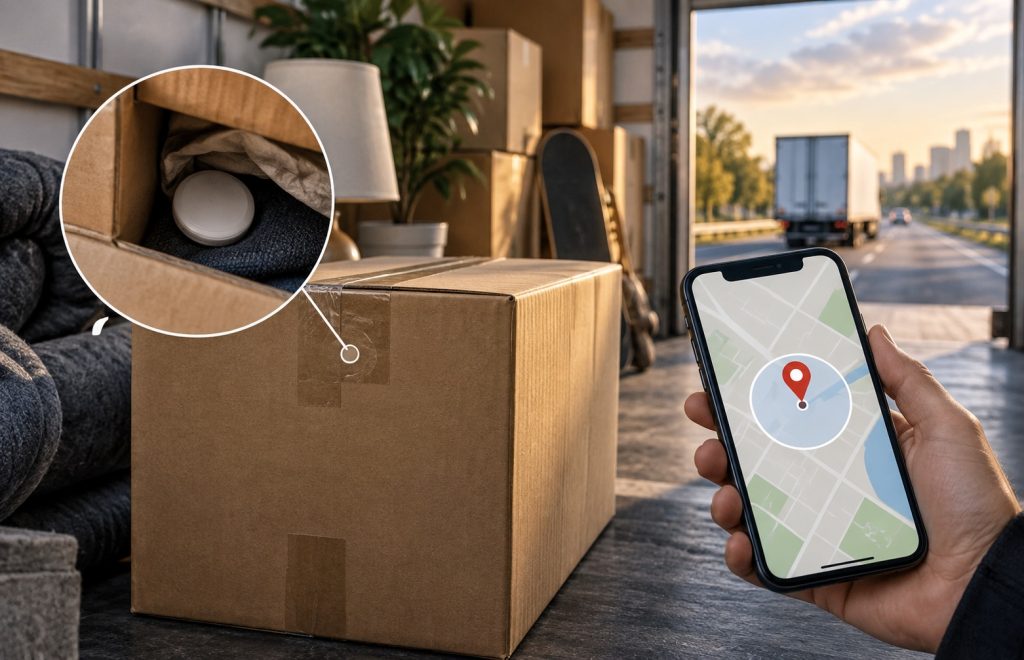
A tag clipped to a backpack sitting in the cab can disappear immediately. A tracker concealed among your own packed possessions may have a better chance of staying with the load.
You may also like to read: Renting Moving Trailers. For small moves, renting a trailer is often a cost-effective solution. In this guide, we explain all you need to know about trailer rental.
What If the Truck Is Recovered but Everything Inside Is Gone?
Unfortunately, recovering the truck doesn’t necessarily mean recovering your goods.
Thieves can abandon the vehicle after unloading the valuable or easily resold items. That’s exactly why reporting the theft quickly and checking available location data can matter.
If police recover the truck, document its condition before anything is moved if you’re permitted to do so. Photograph broken locks, doors, windows, and the remaining cargo.
Then update both U-Haul and your insurer.
Your insurance claim may now be for a mixture of missing property and damaged property rather than a total theft.
Also resist the temptation to clean up immediately.
Photographs showing the condition in which the truck and belongings were recovered can help document the loss.
What If Important Documents Were in the Truck?
This deserves its own section because losing documents creates a second risk: identity theft.
If a Social Security card was taken, the Social Security Administration allows eligible people to request a replacement card and directs people concerned about identity theft involving their Social Security number to the Federal Trade Commission.
If a valid U.S. passport was stolen, the State Department says to report it immediately. Once reported stolen, the passport is canceled and cannot be used for travel even if it later turns up.
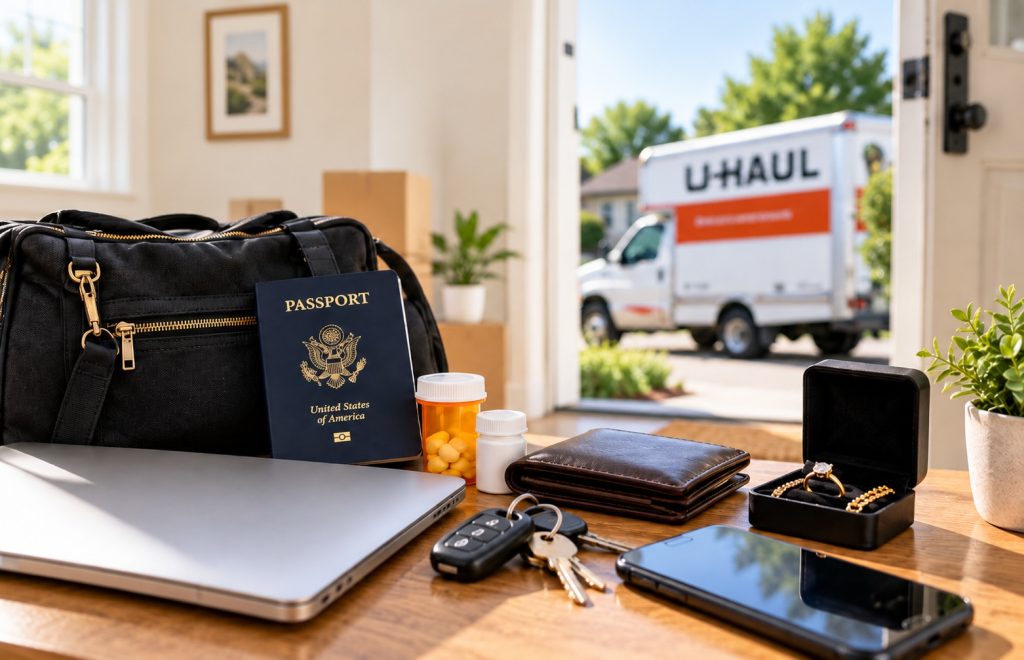
This is also why passports, birth certificates, Social Security cards, checkbooks, immigration documents, prescription medication, irreplaceable photographs, jewelry, cash, and essential electronics generally shouldn’t ride overnight in the back of a rental truck if you can keep them with you.
Your couch belongs in the U-Haul.
Your passport doesn’t.
You may also like to read: How to Prevent Identity Theft. In this guide, we offer some practical tips to help safeguard you against identity theft when moving home.
Where Should You Park a U-Haul Overnight?
The most dangerous part of many long-distance DIY moves isn’t the highway.
It’s the night between driving days.
A loaded rental truck announces exactly what it is: a large box containing somebody’s household possessions.
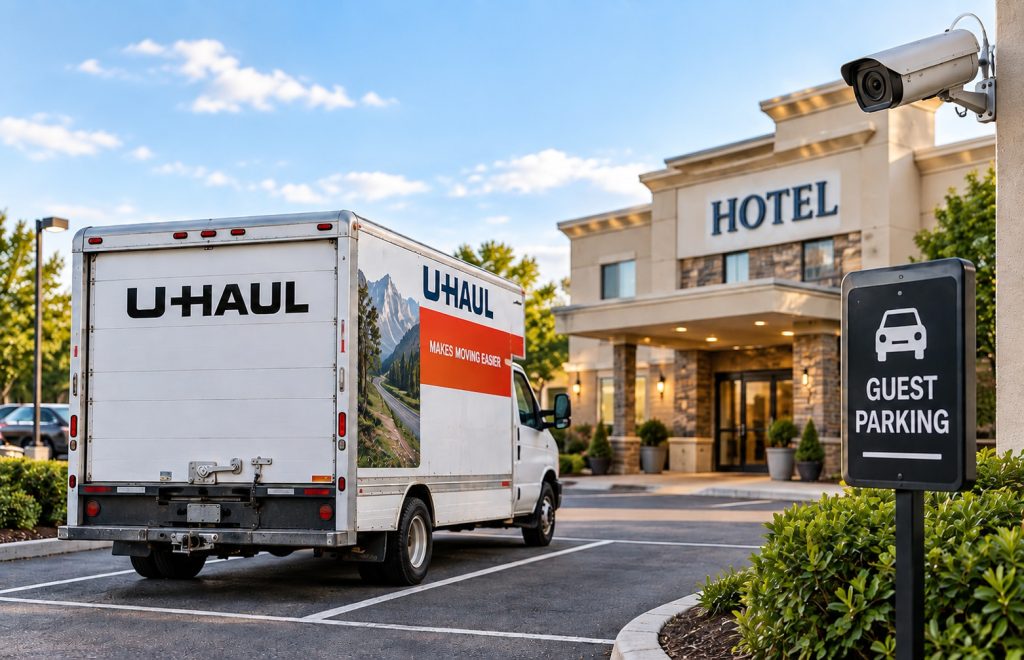
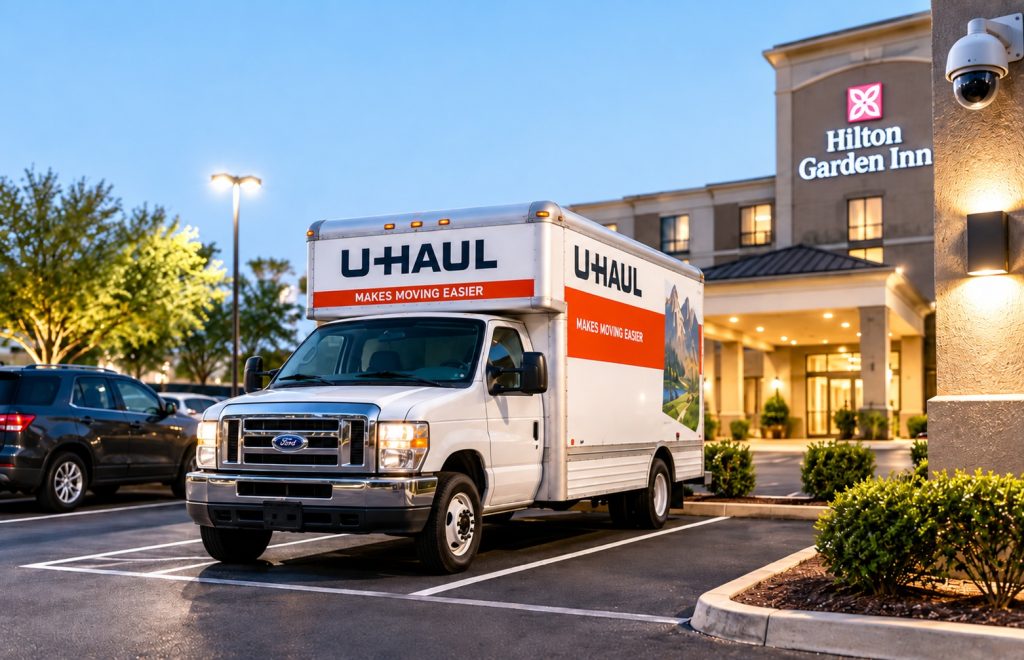
U-Haul’s own overnight-parking guidance recommends well-lit areas, parking near cameras or staff where possible, locking both the cab and cargo compartment, and positioning the rear cargo door toward a wall or other barrier when possible. U-Haul also notes that some of its locations may permit overnight parking if you arrange it with the individual location.
This means hotel choice shouldn’t be based only on the room price.
Before booking an overnight stop during a long-distance move, call the hotel and ask where a 20- or 26-foot moving truck can park, whether that part of the parking lot is covered by cameras, and whether the front desk is staffed overnight.
A $15 difference between hotels suddenly doesn’t look important when $40,000 worth of your life is sitting outside.
And wherever you park, think about two separate problems.
First, someone can break into the cargo area.
Second, someone can steal the entire vehicle.
A strong cargo lock helps with the first problem, but not the second.
How to Make a Loaded U-Haul Harder to Steal
You can’t make a rental truck impossible to steal, but you can make yours considerably less attractive.
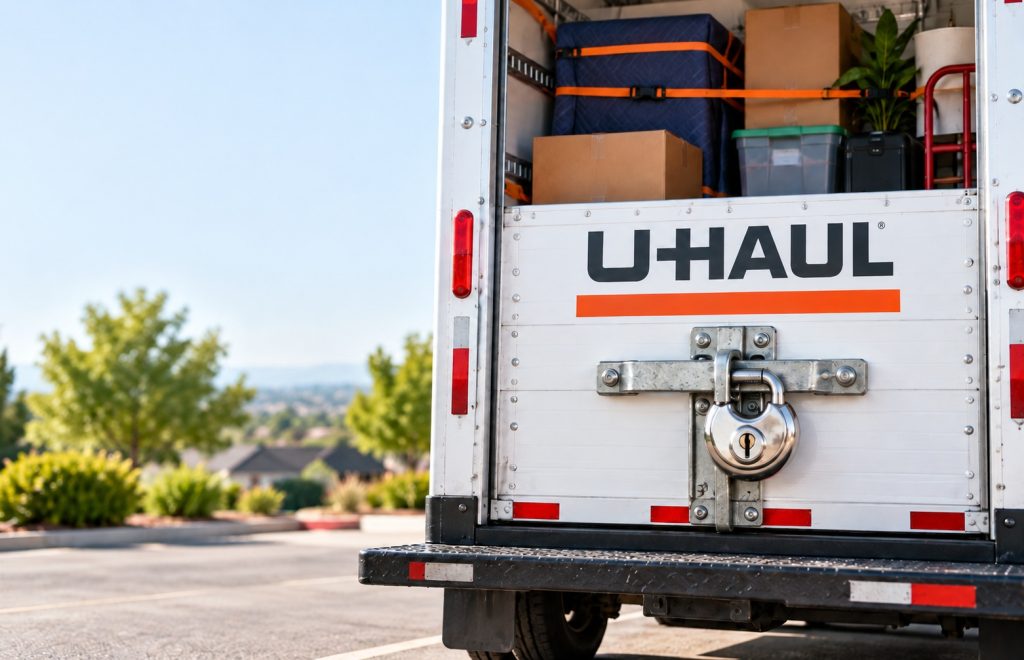
U-Haul recommends securing the cargo door with a sturdy lock; its guidance specifically mentions disc-style locks because their rounded design can expose less material to bolt cutters than a conventional padlock. It also recommends keeping valuable items out of sight in the cab and, where possible, parking the rear door against a wall or barrier.
For an overnight stop, add another layer of security to the vehicle itself rather than relying solely on the cargo-door lock. A visible steering-wheel lock or another appropriate vehicle-theft deterrent can make stealing the entire truck less convenient.
Most importantly, don’t make a thief’s job easy.
- Don’t leave the keys in the truck.
- Don’t leave the truck running while you “just run inside.”
- Don’t park in the darkest corner of an enormous hotel lot because there’s more room.
- Don’t leave expensive electronics sitting on the passenger seat.
- And don’t assume surveillance cameras mean the truck can’t be stolen. Cameras may help an investigation after the fact, but they aren’t a physical barrier.
Do a Five-Minute Video Before You Leave
Here’s one moving task that costs nothing and could save you thousands.
- Walk through the house and record what you are taking with you.
- Document what is inside boxes containing expensive items.
- Photograph serial numbers on major electronics.
- Save receipts for recent purchases.
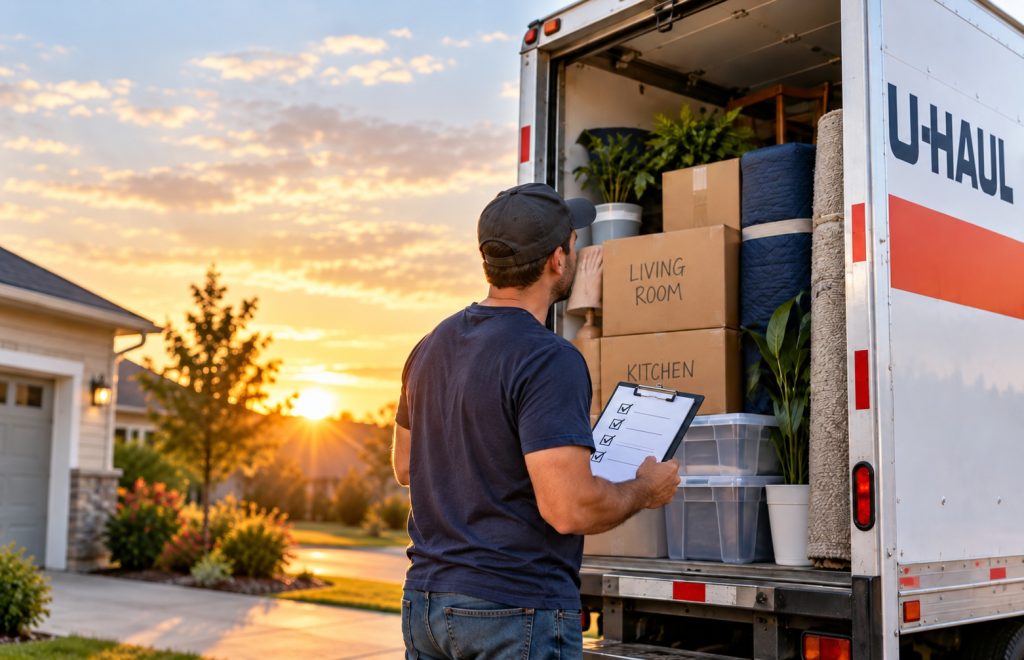
- When the truck is loaded, but before you close the door for the last time, film the contents.
Upload those photographs and videos somewhere other than the phone that will be traveling in the truck.
If the truck disappears, you don’t want the only evidence of your possessions to disappear with it.
U-Haul’s app includes an inventory function that lets customers list possessions and upload photographs, but you can accomplish the same basic goal with your own cloud storage and a simple spreadsheet or home-inventory app.
You may also like to read: How to Make a Moving Inventory. In this guide, we offer tips on how to make a simple but effective inventory for moving home.
Should You Put an AirTag in Your U-Haul?
I would put a tracker with the belongings I was moving, not because it prevents theft, because it doesn’t.
But if the truck or part of the load disappears, knowing that one of your boxes was detected 12 miles away five minutes ago is much more useful than knowing only that the truck used to be in parking space 37.
The better approach is to treat tracking as one layer rather than your entire security plan.
- Lock the cargo area.
- Secure the vehicle.
- Choose the parking spot carefully.
- Keep important documents with you.
- Maintain insurance.
- Create an inventory.
- Then add the tracker.
No single measure will solve the problem, but several small precautions together give you a much better chance of avoiding a catastrophic loss.
Is a Hotel Responsible If Your U-Haul Is Stolen From Its Parking Lot?
Don’t automatically assume it is.
The fact that a truck was stolen while parked at a hotel does not by itself mean the hotel must reimburse you for the vehicle or your possessions.
Liability can depend on the circumstances, representations made by the hotel, local law, and whether negligence can be established.
However, you should still notify the hotel management immediately.
Ask them to preserve surveillance footage, document when the truck entered and left the property, and provide police with any relevant recordings.
If you specifically asked whether secure or monitored moving-truck parking was available before booking, keep any written communication you have.
What Happens If You Didn’t Buy Safemove?
Then you need to determine whether another policy covers the rental vehicle.
Do this immediately rather than assuming your regular auto insurance does.
Moving trucks can fall outside ordinary personal-auto coverage because of their size, weight, or classification. Progressive says most personal auto policies are unlikely to cover large moving trucks, although smaller pickups or vans may sometimes qualify depending on the policy.
U-Haul also warns that many personal auto policies exclude rental trucks.
And don’t count on your credit card simply because it provides rental-car insurance.
Rental-car benefits frequently exclude moving trucks, commercial-type vehicles, or vehicles above certain size or weight limits. Check the actual card benefit terms before the move.
The safest time to figure all of this out is before pickup.
The worst time is standing in an empty parking space at 7 a.m.
Never Leave Valuables in the Truck Overnight
A moving truck is for things that are bulky.
The important things should travel with you whenever possible.
That means the suitcase you bring into the hotel shouldn’t contain only pajamas and a toothbrush.
Use it for the things you would desperately wish you’d kept if the truck disappeared: identification, passports, medication, essential financial documents, irreplaceable family items, backup drives, laptops, small expensive valuables, and anything you need to function for the next several days.
You won’t carry your dining-room table into a Holiday Inn, but you can carry your grandmother’s jewelry.
Before You Rent the Truck, Call Your Insurance Company
This may be the single most useful thing you can do after reading this article.
Don’t ask vaguely whether you’re “covered during a move.”
Describe the exact scenario.
Tell your insurer you’re renting a U-Haul, give them the approximate truck size, explain whether you’re moving locally or across state lines, and ask what happens if the entire loaded truck is stolen.
- Find out your deductible.
- Find out your off-premises personal-property limit.
- Find out whether your belongings are covered while in transit.
- Find out whether valuables have special limits.
- Find out whether you’re covered for actual cash value or replacement cost.
- And ask when your coverage at your old address ends and coverage at your new address begins.
If there is a gap, find it before the moving truck is loaded.
Frequently Asked Questions
Does U-Haul cover theft of my belongings?
U-Haul’s current Safemove and Safemove Plus information says theft of personal contents in the rented truck is not covered. Cargo protection applies to certain other causes of loss or damage, including collision, fire, windstorm, and overturn.
Does Safemove cover the U-Haul itself if it is stolen?
U-Haul says Safemove, Safemove Plus, CDW, and Safetow can cover theft of rented U-Haul equipment if neglect did not contribute to the theft. The exact contract and exclusions applicable to your rental should be read carefully.
Will renters insurance cover belongings stolen from a moving truck?
It may. Renters policies commonly include off-premises theft coverage, but limits, exclusions, and deductibles vary. Some policies can provide significantly less coverage for belongings away from your residence.
Will homeowners insurance cover belongings in a U-Haul?
It may. Homeowners policies often provide personal-property coverage away from home, including theft, but moving and in-transit restrictions can vary by insurer and policy. Confirm the coverage before moving.
Should I call U-Haul or police first?
If you believe the truck has been stolen, contact law enforcement immediately and then notify U-Haul as soon as possible. Have the rental agreement available so you can provide vehicle details quickly.
Can an AirTag help find a stolen moving truck?
An AirTag or another location-enabled device hidden among your possessions may provide useful location information. Apple Find My can show the current or last known location of an AirTag when the network detects it. Give that information to law enforcement rather than attempting to recover stolen property yourself.
What is the best lock for a U-Haul?
U-Haul recommends sturdy security locks for its cargo doors and says some customers prefer disc-style locks for overnight stops because less of the lock is exposed to cutting tools. But remember: a cargo lock protects the door, not the truck from being driven away.
Is it safe to leave a loaded U-Haul at a hotel overnight?
There is always some risk. If an overnight stop is unavoidable, choose parking carefully: somewhere legal, well lit, and preferably visible to cameras or staff. Park the rear cargo door against a wall or barrier where practical, lock the cab and cargo area, and take important valuables and documents into the hotel.
Before You Close That Truck Door
People spend weeks worrying about whether they’ll break a television or scratch a dresser during a DIY move.
Very few stop to ask what happens if the whole truck disappears.
And that’s the bigger risk to prepare for.
A good lock is useful. A tracker is useful. Smart overnight parking is useful.
But none of them replaces knowing what your insurance actually covers.
Before a long-distance DIY move, make sure you know who would pay for the truck, who would pay for your belongings, and how much you would realistically receive if everything vanished tonight.
Then take photographs.
Keep the important things with you.
Lock the truck.
And when you stop for the night, spend five extra minutes thinking about where you’re leaving what may temporarily be the most valuable vehicle you’ve ever parked, not because of the U-Haul itself, but because almost your entire life is sitting inside it.
Renting a moving truck is a big decision to make if you are not familiar with driving a large vehicle. It is such an important topic that you will find a whole section of our home moving blog dedicated to this subject. If you are thinking of renting a moving truck, be sure to read these guides first.
Also Read








Share your thoughts by leaving a comment