

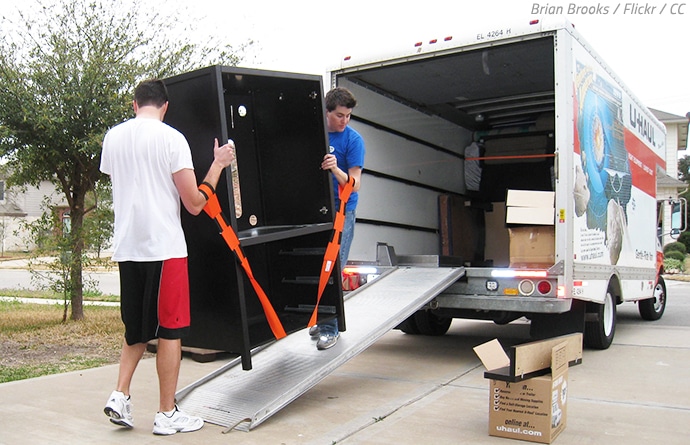
- 1. Shoulder Harness Moving Straps (e.g., Shoulder Dolly — $35–$48): Two movers wear vest-like harnesses connected by a 12-ft central lifting strap under the appliance. Transfers 100% of the weight to your legs and shoulders while keeping both hands free to open doors and grip stair railings. Rated up to 800 lbs.
- 2. Forearm Lifting Straps (e.g., Forearm Forklift — $20–$28): Two crisscross polypropylene straps loop over your forearms or wrists, reducing perceived weight by up to 66%. Best for carrying dressers, mattresses, and sofas through tight doorways.
- 3. Ratchet Tie-Down & Cam Buckle Straps ($15–$35 for a 4-pack): Used inside the moving truck (hooked into E-track rails or tie-down rings) to lock appliances and dolly loads against the truck wall so nothing shifts in transit.
When moving house, you can either hire professional movers to relocate your belongings or rent a moving truck and move your items yourself.
If you choose the second option, you’re going to need some help – and some specialized moving equipment. You can’t possibly do it all on your own (just think of the heavy lifting on moving day) and you can’t do without the right tools and supplies for the job.
There are many different types of moving equipment that can make your move safer, smoother, and easier – moving dollies, furniture sliders, harness straps, etc. Moving straps are among the simplest, yet most highly effective of them – they allow you to lift heavy objects with ease and help keep your items secure during a move.
Lifting straps and ratchet tie down straps – the two types of straps used for moving – have very different roles and purposes in the relocation process, but they’re both extremely helpful during a house move – and they’re both instrumental for a successful and trouble-free relocation.
Read on to find out when and how to use furniture lifting straps and moving tie down straps, so you can make your next relocation as safe and easy as possible.
How to use lifting straps for moving furniture
Furniture moving straps take the weight of a load off your body and lower the center of gravity of the item you’re lifting, allowing you to handle it without bending or twisting your back. The straps keep the heavy object secure and protect your back and shoulders from pain and strain, thus greatly reducing the risk of injuries and accidents during the move.
Lifting straps for moving allow you to lift and carry heavy items with ease by utilizing your own body’s leverage and strength. To ensure safety and achieve maximum efficiency though, you need to use them correctly.
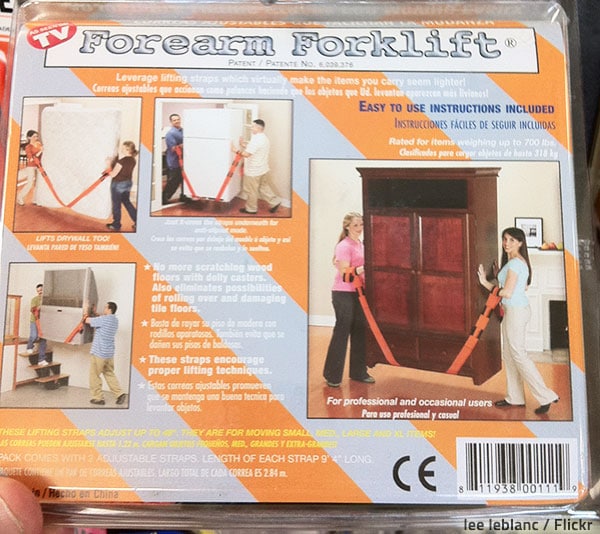
So, how to use furniture moving straps? The specific procedure depends on the type of straps you’re using (see below for details) but there are some general guidelines to follow in all cases:
- Read the instructions that come with your furniture lifting straps before you get down to work, so you know exactly what to do, what to expect, and what moving-related accidents and injuries to be careful about;
- Decide on the best route to take your furniture from its current location to where it needs to go. If you’ll be working with a partner (which is most often the case when using moving straps), let them know exactly where you’ll be passing through and exactly how you’ll be using the lifting straps to move the furniture. Discussing your plan in advance will eliminate the possibility of misunderstanding during the actual move;
- Measure the furniture you’re going to move and all the doorways, hallways, and staircases along the way, so you know if your piece will fit through. You don’t want to lift and carry a heavy item only to find out that it won’t fit through the door, around the corner, or along the stairs;
- Clear the path of obstacles – When carrying a bulky item, you need good visibility and room to maneuver, so you have to make sure that the way is not blocked by anything. Remove any items from your path – and any items hanging on the walls along the way, too;
- Put on comfortable, sturdy shoes that provide a good grip, so you don’t slip while carrying the heavy furniture;
- Place the lifting straps on your forearms or over your shoulders (depending on the type of furniture moving straps you’re using). Your partner should do the same;
- Put the carrying straps on the floor, in front of the furniture piece you want to move;
- Slightly tilt the furniture backward and slide the carrying straps under it;
- Be sure to work in tandem with your partner and communicate all the time. There must be perfect synchronization between the two of you – otherwise, you may drop the item or get injured because of the extra strain.
Now that you know the basics, it’s time to take a look at the specifics. There are two principal designs of furniture moving straps – forearm straps and shoulder straps – and each has its own peculiarities.
Shoulder dolly vs forearm forklift
When it comes to moving heavy items, you have two different types of straps to choose from:
1) Forearm moving straps
Forearm moving straps, also known as a forearm forklift, have loops on both ends of the strap that fit over the forearms. They allow for many different strap configurations which makes them very versatile and very convenient to use.

Keep in mind though that you can’t use forearm straps to move a heavy item on your own – they are two person lifting straps that require you to work with a partner. And you can’t carry as heavy items with a forearm forklift as you can with over the shoulder moving straps – simply because your forearms are not as strong as your shoulders.
Forearm moving straps are very affordable (forearm forklift prices start at around $25) and very easy to use, so they’re the furniture moving equipment of choice for many DIY home movers.
2) Shoulder moving straps
Shoulder moving straps, also known as a shoulder dolly, have a harness that fits over the shoulders. Some models connect behind the back or have an additional chest strap for greater stability.
Shoulder straps distribute weight evenly on the shoulders, allowing you to carry heavy items without too much effort and leaving your hands free to navigate and balance the item.
You can use shoulder straps to move a heavy item on your own – with the help of the so-called one person shoulder dolly – but the typical shoulder dolly is a two-person lifting system. It has great weight capacity and ensures excellent stability, allowing two people to safely lift and carry heavy household items that would otherwise be impossible to move.
Shoulder moving straps are more difficult to put on than forearm straps and a bit more expensive (a shoulder dolly costs about $40-$45), but they’re quite worth it.
Good to know: Whether you’re moving heavy furniture or heavy appliances, you can use the same type of moving straps – there is no difference between furniture moving straps and appliance moving straps. The terms are only used to specify what kind of items the moving straps are being used for during a particular job.
Regardless of their type, the best moving straps are strong, adjustable, and comfortable and make moving heavy items a breeze.
How to use forearm moving straps
Forearm forklifts use leverage to help you lift and carry heavy items without undue stress on your muscles. You just need to make sure that you’re using the straps correctly:
1. Place the carrying straps under the item you want to move:
- If you’re moving a furniture piece or an appliance with legs, place the straps on either end of the item (on the inner side of the legs), running parallel to each other;
- If you’re moving a heavy item without legs, place the straps underneath it in an x-pattern.
2. Choose the right arm loops – or adjust the length of the straps:
- Most forearm moving straps have several different arm loops in order to accommodate furniture and appliance of all shapes and sizes. You need to find the loops that will make the moving straps the right length for lifting the object at least 5’’ off the ground and slide your arms through them (the loops should be positioned on the upper half of your forearms);
- Some forearm straps have tension buckles – you need to insert the strap into the buckle and adjust the length, then position the so-formed loops on your forearms, near the elbows.
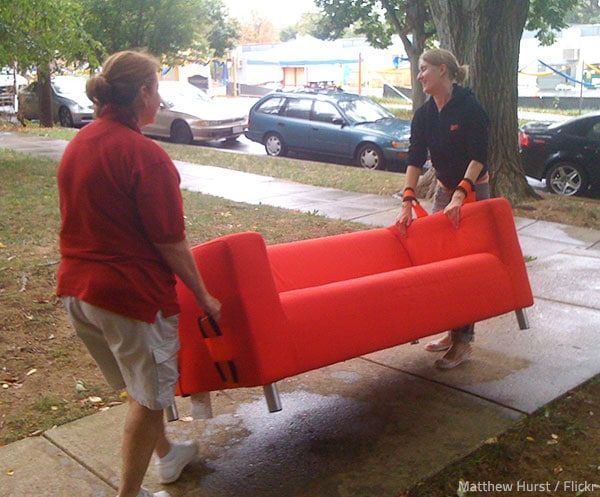
Your partner needs to do the same.
3. Lift the item -With the straps securely positioned on your upper forearms, bend your knees and your arms and get ready to lift the heavy object. Keep your back straight and use your legs to lift up the item.Be sure to stand up simultaneously with your partner.
4. Carefully move the item – Work in tandem with your partner to slowly move the item to where it needs to go (into the moving truck, inside your new home, into a different room, etc.). One of you will have to walk backward and the other – forward, giving directions and warnings.
Depending on the size and shape of the item, it may be better to carry it with your arms bent or with your arms straight out at a slightly upward angle. If the straps are aligned in an x-pattern underneath the item, be sure to bend your arms and balance the piece with your hands while carrying it. Make small steps and keep the weight centered on your legs.
Once you get to your destination, slowly put the item down onto the ground (or onto the floor), remove the loops from your forearms, and remove the straps from under the item.
Related useful information: How to lift and carry heavy items when moving
How to use shoulder moving straps
Shoulder straps for moving furniture and appliances allow for weight distribution and stability, enabling you to move heavy items in a safe and efficient manner. The moving harness system, however, is a bit more difficult to use than the forearm forklift.
Here are the right steps to follow when moving heavy objects with shoulder straps:
Step 1. Suit up. Position the harness moving straps over your shoulders, with the buckle lying flat in front of you and the straps crossing behind your back. Have your partner do the same.
Step 2. Place the long lifting strap under the item you want to move. If you’re moving a furniture piece or an appliance with legs, you can simply slide the strap under the item (between the legs). If the item doesn’t have legs, you’ll have to tip it to the side and slide the strap under it. Make sure the strap is under the bulk of the weight.
Step 3. Buckle up. When the carrying strap is properly positioned under the item,attach one of its ends to your shoulder harness, weaving it through the buckle and over the round bar. Have your partner do the same.
Step 4. Adjust the length. Once both ends of the strap are secure, you need to adjust the length of the strap between the two harnesses so it is appropriate for lifting the object several inches off the ground. Turn the buckle horizontal to the ground and pull the strap end as much as needed – when the buckle is vertical, it will lock and allow you to safely lift the item. If there is too much excess strap hanging from the buckle, tie it around your body or tuck it between the harness and your body so you don’t trip over it while carrying the item.
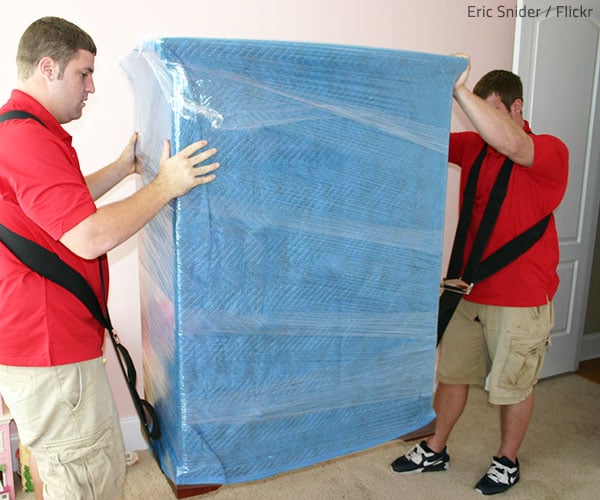
Step 5. Lift the item. With the moving harness system securely in place, bend your knees and place your hands on either side of the item you’re moving. Ensure your partner is doing the same. Keeping your back straight, push against the item and slowly straighten your legs to lift the piece using the leverage from the straps and the strength of your shoulder and leg muscles. Be sure to stand up simultaneously with your partner and to balance the item with your hands.
Step 6. Take the item to where you want it to be. Carry the item very carefully, communicating with your partner all the time. As when using forearm moving straps, one of you will have to walk backward while the other faces forward. Walk slowly, make small steps, and use your hands to stabilize the item as you walk.
Once you get to your destination, lower the item to the ground (or to the floor) and remove the strap from the buckle to free yourself from the piece. Take off your shoulder lifting straps and remove the carrying strap from under the item.
Good to know – How to use moving straps on stairs
If you need to move a furniture piece, an appliance, or any other bulky item up or down stairs, shoulder straps are your best friend – they will help you carry the heavy piece without too much effort and safely navigate the stairs. Use the shoulder dolly as described above, just make sure the stronger partner walks lower on the stairs to support the heavy item from below. It is up to the person higher on the steps to guide and steady the piece.
See also: How to lift heavy boxes and furniture safely
How Much do Movers Cost?
As Featured On:

How to use ratchet straps for moving
Moving tie down straps, also commonly referred to as moving truck straps, are very different from the heavy lifting straps described above. They’re essentially ratchet straps used for securing items in a moving vehicle. And they are imperative for the safe transportation of household goods.
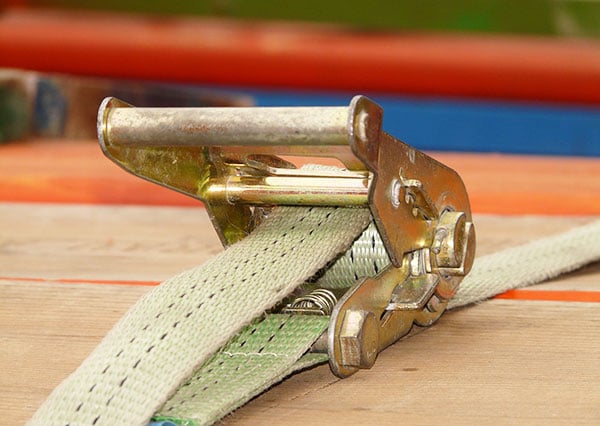
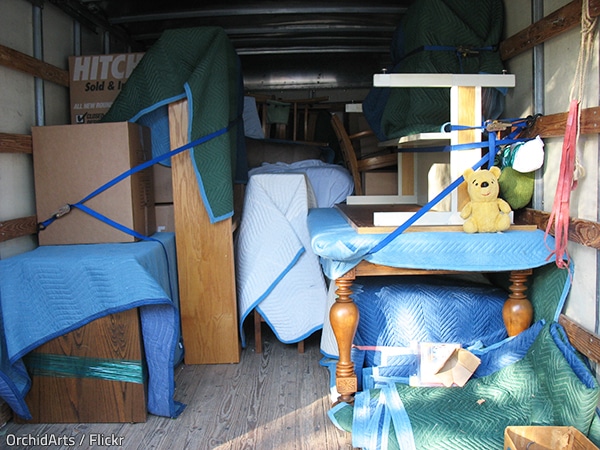
Ratchet straps for moving are primarily used to prevent furniture and other larger household items from moving around the truck during transportation. If the items in the cargo hold are not properly secured, they may shift, topple down, or bump against one another when the truck makes a sudden stop or a sharp turn. To prevent this from happening – and to prevent your belongings from getting damaged as a result – you need to secure the load in the moving truck. And that’s where moving tie-down straps come in.
To be able to ensure the safety of your items during transit, however, you need to know how to use ratchet tie down straps the right way:
Step 1. Prepare the straps
Ratchet straps have two parts:
- the ratchet head – the head is attached to a small piece of strap with a hook on the other end;
- the ratchet strap – a long strap with a hook on one end.
When using ratchet straps for moving trucks, first you need to open the ratchet head and feed the strap through it.
How to open ratchet straps? Pull up the ratchet lever located in the center of the head and flip the ratchet open. Make sure the ratchet head is fully open and the spiked wheels (cogs) are facing up.
How to thread a ratchet strap? Push the free end of the strap through the back of the ratchet head and out the top.
Step 2. Attach the hooks
There are metal bars with notches along the walls of the moving truck – you need to attach the strap hooks to these notches in order to secure an item in the moving truck.
How to tie down furniture in a moving truck?
Position your large furniture piece next to the wall of the moving truck. Place the ratchet strap around the piece and put one of the strap hooks in a notch slightly behind the front of the furniture.
Depending on the size of the furniture and its position in the truck, you can either attach the second hook to a notch on the same metal bar or to a notch on the other side of the truck (make sure the notch is slightly behind the front of the piece – otherwise the ratchet strap won’t keep the piece from sliding from side to side within the moving truck).
When both hooks are in place, pull the free end of the strap to remove any slack between the two hooks.
Step 3. Secure the item
Lastly, you need to tighten the ratchet strap and close the ratchet head.
How to tighten a ratchet strap? Crank the ratchet head to pull the length of the strap through and tighten the strap. The created tension will pull the furniture piece into the moving truck wall and will prevent it from shifting during transportation. (Be careful not to over-tighten though – too much pressure could damage the ratchet strap or the item).
Once the strap feels taut enough, close the ratchet head (flip it into closed position and press it down until you hear it latch) to lock the strap in place.
Your item will be well secured and the risk of damage to it during transit will be reduced to a minimum.
Related: How to load a moving truck
Bonus tip – How to release a ratchet strap
To undo the ratchet strap, you need to pull and hold the release handle located on top of the ratchet head. This will release the lock and you’ll be able to open the ratchet head and pull the strap loose. The only thing that will remain to do then will be to unhook the strap from the moving truck walls.
Knowing how to use straps for moving truck will allow you to properly secure your items during transportation, so they arrive at your new home safe and sound. And that’s the end goal when moving house.
Carrying straps for moving furniture and ratchet tie down straps can make a move safer, easier, and smoother. Yet, if you have large furniture, heavy appliances, and/or other bulky household items to relocate, moving without professional help will still be very difficult, very time-consuming, and very risky – even if you know how to use moving straps to your advantage.
You can save yourself a lot of time and effort – and a lot of nerves – by hiring experienced movers to take care of your belongings. The pros will bring everything necessary – including moving straps – and will do all the work for you, so you’ll have nothing to worry about. Isn’t that just great?
Shoulder Harness vs. Forearm Straps vs. Ratchet Tie-Downs: Which Should You Use?
| Strap type | Rated limit¹ | Est. price | Best for | Safety |
|---|---|---|---|---|
| Shoulder Harness System (2-Person) | Up to 800 lbs | $35 – $48 | Refrigerators, washers, safes, pianos, heavy armoires | Follow the maker’s instructions; use professional help on stairs |
| Forearm Lifting Straps (2-Person) | Up to 600 – 800 lbs | $19 – $28 | Couches, mattresses, medium dressers on flat ground or wide stairs | Never use on top-heavy appliances that can tip forward without a back brace |
| 1-Person Carry / Mattress Strap | Up to 200 lbs | $16 – $24 | Carrying king/queen mattresses, plywood sheets, or large moving boxes solo | Keep back straight and bend at knees; do not exceed solo lifting limits |
| Ratchet Tie-Down Straps (1″–2″ Wide) | 1,000 – 3,000 lb break strength | $18 – $35 (4-pack) | Securing furniture tiers and appliances inside a rental moving truck | Place cardboard or moving pads under the metal ratchet buckle so it doesn’t dent wood furniture |
¹ Ratings vary by product and are not a safe lifting target for a person. Follow the manufacturer’s instructions, assess the route and use professionals for heavy or awkward loads.
Related Furniture Moving Equipment & Pro Guides
Also Read

How to Move a Queen Size Bed by Yourself
Without a doubt, moving a queen-size bed is one of the most difficult things to do during a move. Why? The answer... Read More

How to Move a China Cabinet: Step-By-Step Guide
What will happen if you accidentally drop a book on the floor? Will it break into hundreds of small pieces? No.... Read More

How to Move a Heavy Bookcase to a New Home
A furniture piece full of treasures. If you’re an avid reader, you probably have plenty of books in your home -... Read More
More about the author

Jessica is an experienced moving expert and author of informative relocation articles and useful tips. Writes for MoveAdvisor, formerly MyMovingReviews.com.

Martin is a moving expert and online marketer who’s been involved in the moving industry since 2004. Writes for MoveAdvisor, formerly MyMovingReviews.com.
Posted on
Discussion 0 comments
Leave a comment